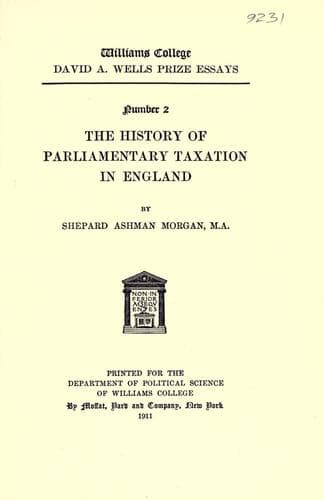
The History of Parliamentary Taxation in EnglandMorgan, Shepard Ashman
History
The History of Parliamentary Taxation in England
Morgan, Shepard Ashman
Taxation -- Great Britain; Taxation -- Great Britain -- History
[Scutage, a cause leading to the Charter]
The importance of the part which scutage played in the tragedy of
John can hardly be overestimated; it was the great moving cause
which brought about the crisis of 1215 and Magna Carta. Not only did
John raise scutage to an amount which had not been equalled since
the Scutage of Toulouse in 1159, but he levied it as though it were
a regular and almost annual obligation. Previously understood as a
commutation arranged at the pleasure of the king for knight’s service
not rendered, as an extraordinary impost reserved for extraordinary
occasions, John changed its character and used it as a means of
supplying his heavy financial needs, irrespective of customary right or
of shrewd policy.
John began with a demand of two marks on the knight’s fee.[64] The
barons had accustomed themselves, during the reigns of Henry and
Richard, to expect at the outside a demand of twenty shillings;
sometimes indeed the imposition had fallen to a single mark or even as
low as ten shillings. His second scutage came in the third year of his
reign, two marks on the fee. Then for four successive years John kept
his barons on edge with annual scutages of two marks each. In 1205-06,
apparently fearing a storm, he reduced his imposition to twenty
shillings, and then waited for three years before laying another. The
three years of relief, however, were not as innocent as they seem;
it was in 1207 that John broke with the Pope, and the freedom to
plunder ecclesiastics which this quarrel gave him, made unnecessary
for the moment any further demands upon the baronage. But this source
of revenue shortly proved insufficient, and John turned again toward
scutage. In the two financial years from 1209 to 1211, he laid three
scutages which aggregated some seventy-three shillings on the knight’s
fee. Then for the space of two years John paused.
[Inquest of Service, 1212]
But it was only a pause. On June 1, 1212, he caused to be taken the
Inquest of Service, by which he sought to bind the cord more tightly
upon his demesne tenants by ascertaining in the now familiar manner of
the local jury, how great was the return which he might expect from
the lands of each crown vassal. It is easy to see in this Inquest,
recalling in its nature Domesday Survey and the Inquest of 1166, the
intended basis for another imposition of scutage.[65] It came in
1213-14, when John made the wholly unprecedented levy of three marks on
the knight’s fee. Apparently he was doing all he could to hurry the
crisis which should lead him to Runnymede.
[Attendant abuses of John’s levies of Scutage]
Public-domain text, read in full here on John Shaqi.
Reviews
Reviews
No reviews yet
Be the first to share your thoughts on this work.
Join the Discussion
Join the discussion
Sign in to leave a comment or review.
Sign InorCreate an account