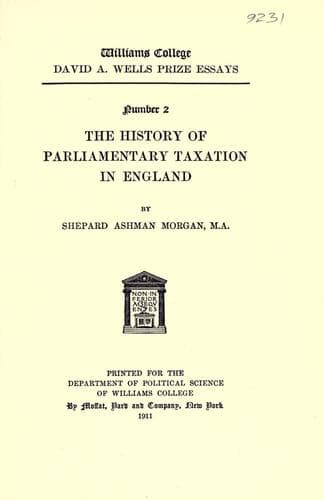
The History of Parliamentary Taxation in EnglandMorgan, Shepard Ashman
History
The History of Parliamentary Taxation in England
Morgan, Shepard Ashman
Taxation -- Great Britain; Taxation -- Great Britain -- History
There were two features of John’s use of scutage aside from the
magnitude and frequency of his levies which made them particularly
onerous. The first had to do with the fines which he exacted from such
of the baronage as were delinquent in paying the imposts of Richard,
some of which had been in arrears since 1190. Miss Norgate notes an
instance which illustrates John’s habit, and throws light upon his
character. Two men of Devon in 1201 were charged with fines by reason
of their absence from the train of Richard in 1193, and the cause
of their failure was this, that “they had been with Count John.” At
the moment John was in rebellion against Richard, but now that he
was become king in Richard’s place, he exacted fines for service the
nonperformance of which he himself had been the cause of.[66] The
collection of fines owing to Richard bore with special heaviness upon
the northern baronage and these, it will be remembered, were the
leaders in the assault upon John in 1215.
The other great abuse which John introduced into the levying of scutage
was his subversion of the theory that the payment of it by the vassal
wholly acquitted him of his obligation to the king for that occasion.
John endeavored in a number of instances to make him liable for
personal service in addition, and for fines in case he failed to be
present in his train. In 1199 John exacted fines from those who did
not accompany him to Normandy; in 1201 he accepted money-payment as a
substitute for service; in 1205 he fined the tenants-in-chivalry after
he dismissed them from service in the host. In these years scutages
were laid as well.[67]
Thus did John make over scutage; it had become a heavy impost upon the
lands of demesne tenants, an almost annual charge, and a tax foreign
to its original character as a commutation for personal service. A
rebellion culminating in the exaction from John of a written contract
between him and the baronage, detailing their mutual relations was the
natural consequence.
[Antagonism of the clergy]
[General demand of a thirteenth of movables]
Public-domain text, read in full here on John Shaqi.
Reviews
Reviews
No reviews yet
Be the first to share your thoughts on this work.
Join the Discussion
Join the discussion
Sign in to leave a comment or review.
Sign InorCreate an account