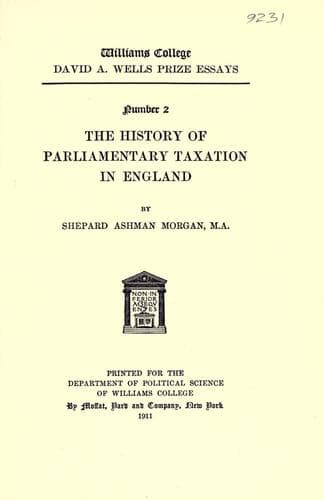
The History of Parliamentary Taxation in EnglandMorgan, Shepard Ashman
History
The History of Parliamentary Taxation in England
Morgan, Shepard Ashman
Taxation -- Great Britain; Taxation -- Great Britain -- History
But the knights were by no means the only body of Englishmen whom John
alienated by his frequent levy of taxes. The clergy, already irritated
by John’s quarrel with the Pope and his seizures of ecclesiastical
property, were ready to combat the king in any further attempt to tax
them. At a Great Council at London on the 8th January, 1207, the king
asked “the bishops and abbots to permit the parsons and the beneficed
clergy to give to the king a fixed sum from their revenues.”[68] The
prelates did not consent, and John brought the matter up again at a
second Great Council which he convened at Oxford on the 9th February.
There were present an “infinite multitude of prelates of the church and
magnates of the realm,” and John again addressed the ecclesiastics. The
bishops “unanimously answered that the English church could in no wise
sustain what was unheard of in all the ages before.” The king, “taking
wise council,” withdrew his demand, but he did not abandon his project.
“Afterward he ordained generally throughout the kingdom that every
man ... give a thirteenth part to the king” of revenue and movables.
The demand applied to all men, no matter from whom they held their
lands.[69] Against the imposition, the earlier analogues of which were
the Saladin Tithe and Richard’s ransom, “all murmured, but none dared
to contradict” the king, except Geoffrey of York; he did not consent,
but openly refused, and then had to fly from England to escape John’s
anger.[70] The writ for the assessment of the thirteenth has it that
the tax was provided “by the common advice and assent of our Council
at Oxford.”[71] How whole-souled was the assent is revealed by the
Chronicler; “none dared to contradict.”
[Normandy is lost]
The time was at hand when men would not longer endure the extortionate
exercise of an unchallenged royal right. There were a number of
conditions and circumstances aside from the burdensome taxes which were
pointing toward Runnymede and Magna Carta. By 1204 John had come to the
end of his day in France. Normandy was lost. The effect upon England
was marked; the Norman baronage was obliged to choose between England
and the Continent. Hereafter tyranny and good-rule of the English kings
were alike felt solely at home, and the barons cast their eyes not
across the Channel, but upon their lands in England. The English were
for England and the nation was born, the first conscious act of which
was to be the enactment of Magna Carta.
During the seven years from 1206-1213 John had his disgraceful quarrel
with the pope, a quarrel which ended in the enfeoffment of England with
Innocent as feudal overlord. The matter is foreign to the subject in
hand, save as the struggle, especially in the early development of it,
gave John a pretext for confiscating the ecclesiastical holdings and
thereby relieving the barons of a scutage for the space of about four
years.
Public-domain text, read in full here on John Shaqi.
Reviews
Reviews
No reviews yet
Be the first to share your thoughts on this work.
Join the Discussion
Join the discussion
Sign in to leave a comment or review.
Sign InorCreate an account