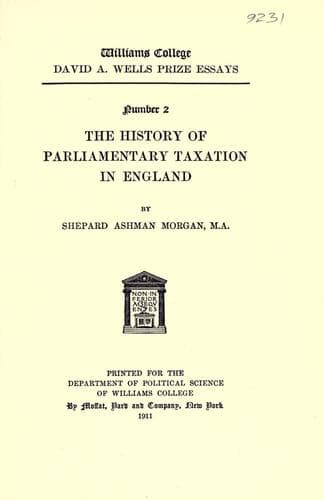
The History of Parliamentary Taxation in EnglandMorgan, Shepard Ashman
History
The History of Parliamentary Taxation in England
Morgan, Shepard Ashman
Taxation -- Great Britain; Taxation -- Great Britain -- History
John, conceiving that peace with the Pope meant full mastery of
affairs, was seized with an ambition to reconquer Normandy. To this end
he tried to induce the barons to follow him into Poictou. They refused,
first on the ground that John was not yet fully absolved from his
excommunication; and then, after this objection was removed by Stephen
Langton on the 20th July, 1213, they raised the old plea that they were
not bound by their tenure to follow the king abroad. John determined to
enforce their attendance upon him by show of arms.
[Council at St. Albans, 4th August, 1213]
Before he started to the north, where the seditious movement had
its center, an assembly was held at St. Albans on the 4th August by
Archbishop Langton, and the justiciar Geoffrey Fitz-Peter. Its purpose
was to assess the amount due to the ecclesiastics in consequence of the
damage sustained by church property during the quarrel with the Pope.
But its great importance lay in the body of men who made it up. It is
in so far as we have record, the first occasion that representatives
of the lesser folk were summoned to a National Council.[72] Beside
the bishops and barons who attended, there were present the reeve and
four men from each township on the royal demesne. The Council advanced
somewhat beyond the simple purpose for which it was summoned; the
justiciar issued an edict against unjust exactions, to be observed as
the sheriffs valued their lives and limbs, and commanded the observance
of the good laws of Henry I.[73]
[Non-noble representatives called to Oxford, 1213]
Later in the year to Oxford, the non-noble representatives were again
called, and at the initiation of John himself. John hoped to win to
himself by this act of respect the support of the smaller landowners
against the threatening barons. The sheriffs were to send up, beside
the knights holding from the king, four discreet men from each county
“to talk with us,” as the writ had it, “concerning the business of our
realm.”[74] This, provided subsequent events had kept pace with it, was
an immensely long step forward; indeed the provisions of Magna Carta
themselves do not advance to the point thus falteringly and unworthily
reached by John. It provided a precedent for the representation of the
third estate in the councils of the nation; and though it is not known
whether or not any action was taken relative to the levying of taxes,
or even whether the council was held at all, nevertheless the fact
that representation for the moment was provided for, marks the step in
the light of the present, as of great, almost of profound, importance
in the consideration of parliamentary taxation.
[Events leading to Runnymede]
Public-domain text, read in full here on John Shaqi.
Reviews
Reviews
No reviews yet
Be the first to share your thoughts on this work.
Join the Discussion
Join the discussion
Sign in to leave a comment or review.
Sign InorCreate an account