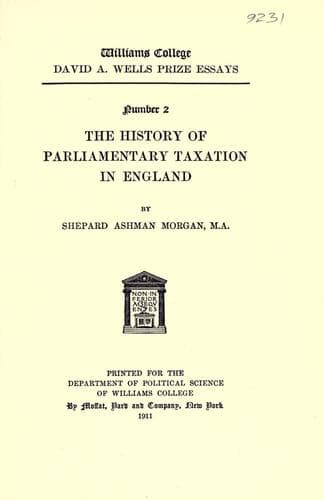
The History of Parliamentary Taxation in EnglandMorgan, Shepard Ashman
History
The History of Parliamentary Taxation in England
Morgan, Shepard Ashman
Taxation -- Great Britain; Taxation -- Great Britain -- History
It would be wandering far afield to trace the final struggles of John
with his infuriated barons. It is sufficient to note that it was an
unauthoritative demand of taxation which pulled the structure of John’s
misgovernment crashing down upon his head. On the 26th May, 1214, John
issued writs for the collection of a scutage at the quite unprecedented
rate of three marks on the knight’s fee, for which there was not a
shadow of consent. The northern barons, the same who had refused
personal service, now refused likewise to pay scutage. In the face of
precedent to the contrary, they denied their liability to follow him,
not merely to Poictou but to any district beyond the Channel, or to
pay him composition for not doing so.[75] At his interview with the
contumacious barons in November at Bury St. Edmunds, he reiterated his
demand, but they remained steadfast in their refusal.
From that time until King and Barons met on the meadow near the Thames
called Runnymede, John’s sky was darkening. He did his best to avoid
the tempest, but with no success. He attempted to break the union of
his enemies by giving the church and the people of London special
charters; it was the church, headed by Stephen Langton, which stood
shoulder to shoulder with the barons in unending hostility to John, and
it was the citizens of London whose adherence to the baronial cause
determined the final contest against the king. John bought the services
of mercenaries to fight his battles for him, but when he became
penniless, they fell away. With every expedient he could summon in his
extremity, he tried to avoid the breaking of the storm. But the whole
nation was against him. The men of the North, who had been steadfast
from the beginning in their opposition to John, were joined by barons
of similar mettle throughout the rest of England. The citizens of
London when they joined the ranks of John’s enemies were followed
by the earlier partisans of the king, save only those few who were
attached by interest or necessity. He signed the Charter the 15th June,
1215, in the full hope that with the passing of the tempest he might
forget his promises.
[Magna Carta, 15th June, 1215]
Public-domain text, read in full here on John Shaqi.
Reviews
Reviews
No reviews yet
Be the first to share your thoughts on this work.
Join the Discussion
Join the discussion
Sign in to leave a comment or review.
Sign InorCreate an account