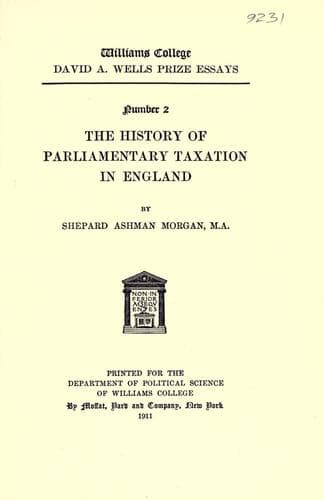
The History of Parliamentary Taxation in EnglandMorgan, Shepard Ashman
History
The History of Parliamentary Taxation in England
Morgan, Shepard Ashman
Taxation -- Great Britain; Taxation -- Great Britain -- History
The Great Charter, in form granted by John as a voluntary gift to the
nation, was in reality a treaty concluded between him and his barons.
That its provisions relative to taxation are important has already
been hinted at; as a matter of history, the recurrence of references
to these particular sections of the Charter proves the esteem in which
Englishmen of later generations regarded this early book of their
Bible of Liberties. Whether this veneration, displayed by the framers
of subsequent and perhaps equally important instruments, was based
upon the intrinsic value of the Charter or upon nothing firmer than
sentiment, is somewhat of a mooted question.[76] The fact that it was
held in such esteem is for us the important and sufficient reason for
considering it in detail. It is essential to understand upon what the
later champions of parliamentary taxation based their arguments, even
though those arguments presumed interpretations of Magna Carta which
the framers of the Charter would have been far from admitting.
[Chapter 12]
The twelfth chapter,[77] taken with the fourteenth,[78] serves as
the legal basis for much of the eloquence against arbitrary taxation
from the time of John to the acceptance of the United States
Constitution. It has been taken to admit “the right of the nation to
ordain taxation”[79] and even as the surrender of the “royal claim to
arbitrary taxation.”[80] An analysis of the contents and application of
the twelfth chapter together with additional comment on the fourteenth
may throw some light on the substance for these assertions.[81]
The impositions which are specified in the chapter are “scutage” and
“aid.” The arbitrary levy of scutage upon the lands of his tenants
was the chief moving cause which brought John to Runnymede, and this
chapter undertook the correction of the abuse of abuses. The aids
mentioned are to be distinguished from the incidents of feudal tenure,
reliefs, marriages, primer seisins, and similar payments which are
dealt with elsewhere in the Charter and belong to the peculiar history
of feudalism. The twelfth chapter provides that the three ordinary
aids--for ransoming the king, for knighting his eldest son, and for
the marriage of his eldest daughter--should be reasonable in amount.
These might be exacted by the king as a matter of course, without the
common council of the realm. The extraordinary aids, which the Charter
places in the same category with scutages, include all other arbitrary
feudal exactions levied to meet some particular emergency and in an
unusual manner. The Charter places both these extraordinary aids and
the obnoxious scutages beyond the pale of royal imposition; hereafter
they are leviable only “by common counsel” of the kingdom. That they
were to be laid by the body known as the Common Council is indicated by
the provisions of Chapter Fourteen.
[Provision regarding London]
Public-domain text, read in full here on John Shaqi.
Reviews
Reviews
No reviews yet
Be the first to share your thoughts on this work.
Join the Discussion
Join the discussion
Sign in to leave a comment or review.
Sign InorCreate an account