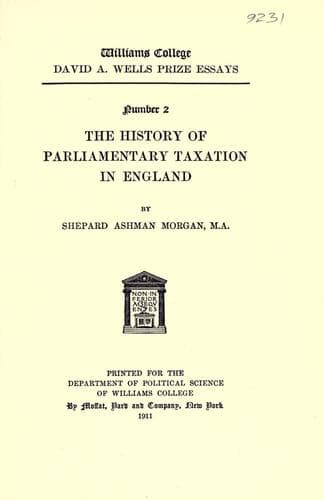
The History of Parliamentary Taxation in EnglandMorgan, Shepard Ashman
History
The History of Parliamentary Taxation in England
Morgan, Shepard Ashman
Taxation -- Great Britain; Taxation -- Great Britain -- History
The people of London rightfully expected to benefit by the granting
of the Charter. According to the last clause of the Twelfth Chapter,
it was to “be done concerning the aids of the city of London” in the
“same way.” The provision is indefinite; whether the “aids” were also
to include in their category the more arbitrary and therefore more
obnoxious tallage[82] is unknown. The aids were for the most part
free-will offerings of the city itself, whereas the tallages were
exacted by the king upon his own arbitrary authority as one having the
power of a demesne lord over London. And whether or not the phrase “in
the same way” means that aids shall be levied by the common counsel
of the realm, or merely that they shall be of “reasonable” amount, is
difficult of determination. If indeed the former idea was in the minds
of the framers of the Charter, when they came to the section providing
for the composition of the Common Council, they made no provision for
the attendance of any member of the corporation of London, or even for
securing their consent. At all events, the king continued to tallage
London at not infrequent intervals and almost without question until
1340, when Parliament took the privilege away from Edward III.
[Chapter 14]
Before we advance to a consideration of the true importance of the
Twelfth Chapter, in order to have a complete understanding of its
position in the line of progress toward parliamentary taxation, we
are obliged to look at the method by which the common counsel of the
kingdom was to be taken. Chapter Fourteen[83] lays down the rule
according to which the assembly was to be called that should hold
this power of assenting to scutages and aids. The method of summons
was simple; it involved the issuance of writs, individually to the
archbishops, bishops, abbots, earls, and the greater barons, and
collectively to the lesser barons through the agency of the royal
sheriffs and bailiffs. The writs gave at least forty days’ notice as
to the place and time of meeting, and specified the business which
furnished the occasion for the Council. As for its composition, the
answer is very simple; it was a gathering of tenants-in-chief of the
king, of crown vassals. The line between the greater and the lesser
barons was ill-defined. Roughly, however, it divided the baronage into
classes, one of which included the baron whose holdings embraced the
major part of a county, and the other the tenant of the king whose
dwelling was a cottage set in his dozen acres. It is probable that the
lesser barons played no considerable part in the assembly, and that
their attendance or non-attendance was of little consequence. The light
of the lesser folk was as yet hid under the bushel.
[The advance toward Parliamentary taxation]
Public-domain text, read in full here on John Shaqi.
Reviews
Reviews
No reviews yet
Be the first to share your thoughts on this work.
Join the Discussion
Join the discussion
Sign in to leave a comment or review.
Sign InorCreate an account