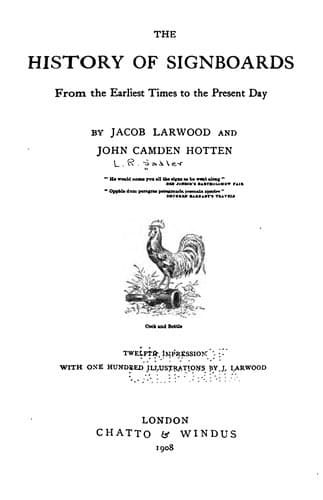
The History of Signboards, from the Earliest times to the Present DayHotten, John Camden
History
The History of Signboards, from the Earliest times to the Present Day
Hotten, John Camden
Inn signs -- England -- History; Signs and signboards -- History
Along with these very simple signs, at a later period, coats of arms,
crests, and badges, would gradually make their appearance at the doors
of shops and inns. The reasons which dictated the choice of such
subjects were various. One of the principal was this. In the Middle
Ages, the houses of the nobility, both in town and country, when the
family was absent, were used as hostelries for travellers. The family
arms always hung in front of the house, and the most conspicuous object
in those arms gave a name to the establishment amongst travellers, who,
unacquainted with the mysteries of heraldry, called a lion gules or
azure by the vernacular name of the _Red_ or _Blue Lion_.[12] Such coats
of arms gradually became a very popular intimation that there was--
“Good entertainment for all that passes,--
Horses, mares, men, and asses;”
and innkeepers began to adopt them, hanging out red lions and green
dragons as the best way to acquaint the public that they offered food
and shelter.
Still, as long as civilisation was only at a low ebb, the so-called
open-houses few, and competition trifling, signs were of but little use.
A few objects, typical of the trade carried on, would suffice; a knife
for the cutler, a stocking for the hosier, a hand for the glover, a pair
of scissors for the tailor, a bunch of grapes for the vintner, fully
answered public requirements. But as luxury increased, and the number of
houses or shops dealing in the same article multiplied, something more
was wanted. Particular trades continued to be confined to particular
streets; the desideratum then was, to give to each shop a name or token
by which it might be mentioned in conversation, so that it could be
recommended and customers sent to it. Reading was still a scarce
acquirement; consequently, to write up the owner’s name would have been
of little use. Those that could, advertised their name by a rebus; thus,
a hare and a bottle stood for Harebottle, and two cocks for Cox. Others,
whose names no rebus could represent, adopted pictorial objects; and, as
the quantity of these augmented, new subjects were continually required.
The animal kingdom was ransacked, from the mighty elephant to the humble
bee, from the eagle to the sparrow; the vegetable kingdom, from the
palm-tree and cedar to the marigold and daisy; everything on the earth,
and in the firmament above it, was put under contribution. Portraits of
the great men of all ages, and views of towns, both painted with a great
deal more of fancy than of truth; articles of dress, implements of
trades, domestic utensils, things visible and invisible, _ea quæ sunt
tamquam ea quæ non sunt_, everything was attempted in order to attract
attention and to obtain publicity. Finally, as all signs in a town were
painted by the same small number of individuals, whose talents and
imagination were limited, it followed that the same subjects were
naturally often repeated, introducing only a change in the colour for a
difference.
Public-domain text, read in full here on John Shaqi.
Reviews
Reviews
No reviews yet
Be the first to share your thoughts on this work.
Join the Discussion
Join the discussion
Sign in to leave a comment or review.
Sign InorCreate an account