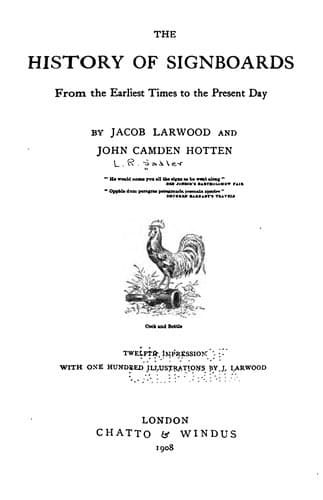
The History of Signboards, from the Earliest times to the Present DayHotten, John Camden
History
The History of Signboards, from the Earliest times to the Present Day
Hotten, John Camden
Inn signs -- England -- History; Signs and signboards -- History
Since all the pictorial representations were, then, of much the same
quality, rival tradesmen tried to outvie each other in the size of their
signs, each one striving to obtrude his picture into public notice by
putting it out further in the street than his neighbour’s. The “Liber
Albus,” compiled in 1419, names this subject amongst the Inquisitions at
the Wardmotes: “Item, if the ale-stake of any tavern is longer or
extends further than ordinary.” And in book iii. part iii. p. 389, is
said:--
“Also, it was ordained that, whereas the ale-stakes projecting in
front of taverns in Chepe, and elsewhere in the said city, extend too
far over the King’s highways, to the impeding of riders and others,
and, by reason of their excessive weight, to the great deterioration
of the houses in which they are fixed;--to the end that opportune
remedy might be made thereof, it was by the Mayor and Aldermen granted
and ordained, and, upon summons of all the taverners of the said city,
it was enjoined upon them, under pain of paying forty pence[13] unto
the Chamber of the Guildhall, on every occasion upon which they should
transgress such ordinance, that no one of them in future should have a
stake, bearing either his sign, or leaves, extending or lying over the
King’s highway, of greater length than seven feet at most, and that
this ordinance should begin to take effect at the Feast of Saint
Michael, then next ensuing, always thereafter to be valid and of full
effect.”
The booksellers generally had a woodcut of their signs for the colophon
of their books, so that their shops might get known by the inspection of
these cuts. For this reason, Benedict Hector, one of the early Bolognese
printers, gives this advice to the buyers in his “Justinus et Florus:”--
“Emptor, attende quando vis emere libros formatos in officina mea
excussoria, inspice signum quod in liminari pagina est, ita numquam
falleris. Nam quidam malevoli Impressores libris suis inemendatis et
maculosis apponunt nomen meum ut fiant vendibiliores.”[14]
Jodocus Badius of Paris, gives a similar caution:--
“Oratum facimus lectorem ut signum inspiciat, nam sunt qui titulum
nomenque Badianum mentiantur et laborem suffurentur.”[15]
Aldus, the great Venetian printer, exposes a similar fraud, and points
out how the pirate had copied the sign also in his colophon; but, by
inadvertency, making a slight alteration:--
“Extremum est ut admoneamus studiosissimum quemque, Florentinos
quosdam impressores, cum viderint se diligentiam nostram in castigando
et imprimendo non posse assequi, ad artes confugisse solitas; hoc est
Grammaticis Institutionibus Aldi in sua officina formatis, notam
Delphini Anchoræ Involuti nostram apposuisse; sed ita egerunt ut
quivis mediocriter versatus in libris impressionis nostræ animadvertit
illos impudenter fecisse. Nam rostrum Delphini in partem sinistram
vergit, cum tamen nostrum in dexteram totum demittatur.”[16]
Public-domain text, read in full here on John Shaqi.
Reviews
Reviews
No reviews yet
Be the first to share your thoughts on this work.
Join the Discussion
Join the discussion
Sign in to leave a comment or review.
Sign InorCreate an account