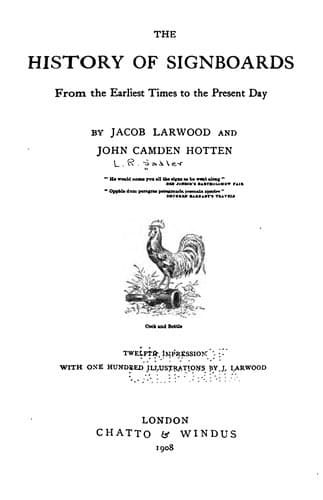
The History of Signboards, from the Earliest times to the Present DayHotten, John Camden
History
The History of Signboards, from the Earliest times to the Present Day
Hotten, John Camden
Inn signs -- England -- History; Signs and signboards -- History
Lastly, there was in London another class of houses that had a peculiar
way of placing their signs--viz., the Stews upon the Bankside, which
were, by a proclamation of 37 Hen. VIII., “whited and painted with signs
on the front, for a token of the said houses.” Stow enumerates some of
these symbols, such as the Cross-Keys, the Gun, the Castle, the Crane,
the Cardinal’s Hat, the Bell, the Swan, &c.
Still greater variety in the construction of the signs existed in
France; for besides the painted signs in the iron frames, the
shopkeepers in Paris, according to H. Sauval, (“Antiquités de la Ville
de Paris,”) had anciently banners hanging above their doors, or from
their windows, with the sign of the shop painted on them; whilst in the
sixteenth century carved wooden signs were very common. These, however,
were not suspended, but formed part of the wooden construction of the
house; some of them were really _chefs-d’œuvres_, and as careful in
design as a carved cathedral stall. Several of them are still remaining
in Rouen and other old towns; many also have been removed and placed in
various local museums of antiquities. The most general rule, however, on
the Continent, as in England, was to have the painted signboard
suspended across the streets.
An observer of James I.’s time has jotted down the names of all the
inns, taverns, and side streets in the line of road between Charing
Cross and the old Tower of London, which document lies now embalmed
amongst the Harl. MS., 6850, fol. 31. In imagination we can walk with
him through the metropolis:--
“On the way from Whitehall to Charing Cross we pass: the White Hart,
the Red Lion, the Mairmade, iij. Tuns, Salutation, the Graihound, the
Bell, the Golden Lyon. In sight of Charing Crosse: the Garter, the
Crown, the Bear and Ragged Staffe, the Angel, the King Harry Head.
Then from Charing Cross towards ye cittie: another White Hart, the
Eagle and Child, the Helmet, the Swan, the Bell, King Harry Head, the
Flower-de-luce, Angel, the Holy Lambe, the Bear and Harroe, the
Plough, the Shippe, the Black Bell, another King Harry Head, the Bull
Head, the Golden Bull, ‘a sixpenny ordinarye,’ another Flower-de-luce,
the Red Lyon, the Horns, the White Hors, the Prince’s Arms, Bell
Savadge’s In, the S. John the Baptist, the Talbot, the Shipp of War,
the S. Dunstan, the Hercules or the Owld Man Tavern, the Mitar,
another iij. Tunnes Inn, and a iij. Tunnes Tavern, and a Graihound,
another Mitar, another King Harry Head, iij. Tunnes, and the iij.
Cranes.”
Having walked from Whitechapel “straight forward to the Tower,” the good
citizen got tired, and so we hear no more of him.
Public-domain text, read in full here on John Shaqi.
Reviews
Reviews
No reviews yet
Be the first to share your thoughts on this work.
Join the Discussion
Join the discussion
Sign in to leave a comment or review.
Sign InorCreate an account