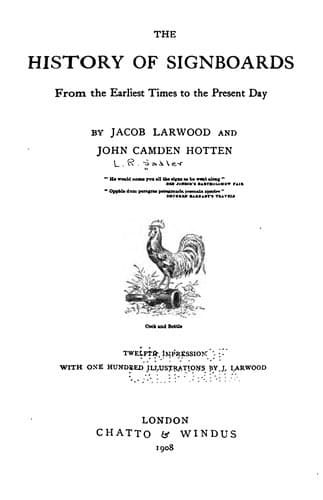
The History of Signboards, from the Earliest times to the Present Day — John Shaqi
The History of Signboards, from the Earliest times to the Present DayHotten, John Camden
History
The History of Signboards, from the Earliest times to the Present Day
Hotten, John Camden
Inn signs -- England -- History; Signs and signboards -- History
This indeed, from the various allusions made to it in the literature of
the last century, was regarded as a very general hint to the lounger,
either to hurry home, or hail a sedan-chair or coach. Gay, in his
didactic--_flâneur_--poem, points out another benefit to be derived from
the signboards:--
“If drawn by Bus’ness to a street unknown,
Let the sworn Porter point thee through the town;
Be sure observe the Signs, for Signs remain
Like faithful Landmarks to the walking Train.”
Besides, they offered constant matter of thought, speculation, and
amusement to the curious observer. Even Dean Swift, and the Lord High
Treasurer Harley,
“Would try to read the lines
Writ underneath the country signs.”
And certainly these productions of the country muse are often highly
amusing. Unfortunately for the compilers of the present work, they have
never been collected and preserved; although they would form a not
unimportant and characteristic contribution to our popular literature.
Our Dutch neighbours have paid more attention to this subject, and a
great number of their signboard inscriptions were, towards the close of
the seventeenth century, gathered in a curious little 12mo volume,[26]
to which we shall often refer. Nay, so much attention was devoted to
this branch of literature in that country, that a certain H. van den
Berg, in 1693, wrote a little volume,[27] which he entitled a “Banquet,”
giving verses adapted for all manner of shops and signboards; so that a
shopkeeper at a loss for an inscription had only to open the book and
make his selection; for there were rhymes in it both serious and
jocular, suitable to everybody’s taste. The majority of the Dutch
signboard inscriptions of that day seem to have been eminently
characteristic of the spirit of the nation. No such inscriptions could
be brought before “a discerning public,” without the patronage of some
holy man mentioned in the Scriptures, whose name was to stand there for
no other purpose than to give the Dutch poet an opportunity of making a
jingling rhyme; thus, for instance,--
“Jacob was David’s neef maar ’t waren geen Zwagers.
Hier slypt men allerhande Barbiers gereedschappen, ook voor vischwyven
en slagers.”[28]
Or another example:--
“Men vischte Moses uit de Biezen,
Hier trekt men tanden en Kiezen.”[29]
In the beginning of the eighteenth century, we find the following signs
named, which puzzled a person of an inquisitive turn of mind, who wrote
to the _British Apollo_,[30] (the meagre _Notes and Queries_ of those
days,) in the hope of eliciting an explanation of their quaint
combination:--
“I’m amazed at the Signs
As I pass through the Town,
To see the odd mixture:
A Magpie and Crown,
The Whale and the Crow,
The Razor and Hen,
The Leg and Seven Stars,
The Axe and the Bottle,
The Tun and the Lute,
The Eagle and Child,
The Shovel and Boot.”
Public-domain text, read in full here on John Shaqi.
Reviews
Reviews
No reviews yet
Be the first to share your thoughts on this work.
Join the Discussion
Join the discussion
Sign in to leave a comment or review.
Sign InorCreate an account