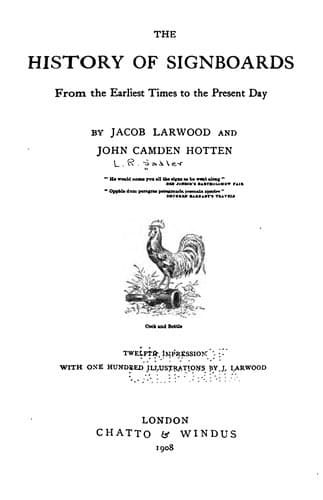
The History of Signboards, from the Earliest times to the Present DayHotten, John Camden
History
The History of Signboards, from the Earliest times to the Present Day
Hotten, John Camden
Inn signs -- England -- History; Signs and signboards -- History
All these signs are also named by Tom Brown:[31]--“The first amusements
we encountered were the variety and contradictory language of the signs,
enough to persuade a man there were no rules of concord among the
citizens. Here we saw Joseph’s Dream, the Bull and Mouth, the Whale and
Crow, the Shovel and Boot, the Leg and Star, the Bible and Swan, the
Frying-pan and Drum, the Lute and Tun, the Hog in Armour, and a
thousand others that the wise men that put them there can give no reason
for.”
From this enumeration, we see that a century had worked great changes in
the signs. Those of the beginning of the seventeenth century were all
simple, and had no combinations. But now we meet very heterogeneous
objects joined together. Various reasons can be found to account for
this. First, it must be borne in mind that most of the London signs had
no inscription to tell the public “this is a lion,” or, “this is a
bear;” hence the vulgar could easily make mistakes, and call an object
by a wrong name, which might give rise to an absurd combination, as in
the case of the Leg and Star; which, perhaps, was nothing else but the
two insignia of the order of the Garter; the garter being represented in
its natural place, on the leg, and the star of the order beside it.
Secondly, the name might be corrupted through faulty pronunciation; and
when the sign was to be repainted, or imitated in another street, those
objects would be represented by which it was best known. Thus the Shovel
and Boot might have been a corruption of the Shovel and Boat, since the
Shovel and Ship is still a very common sign in places where grain is
carried by canal boats; whilst the Bull and Mouth is said to be a
corruption of the Boulogne Mouth--the Mouth of Boulogne Harbour.
Finally, whimsical shopkeepers would frequently aim at the most odd
combination they could imagine, for no other reason but to attract
attention. Taking these premises into consideration, some of the signs
which so puzzled Tom Brown might be easily accounted for; the Axe and
Bottle, in this way, might have been a corruption of the Battle-axe. The
Bible and Swan, a sign in honour of Luther, who is generally represented
by the symbol of a swan, a figure of which many Lutheran Churches have
on their steeple instead of a weathercock; whilst the Lute and Tun was
clearly a pun on the name of Luton, similar to the Bolt and Tun of Prior
Bolton, who adopted this device as his rebus.
Other causes of combinations, and many very amusing and instructive
remarks about signs, are given in the following from the _Spectator_,
No. 28, April 2, 1710:--
Public-domain text, read in full here on John Shaqi.
Reviews
Reviews
No reviews yet
Be the first to share your thoughts on this work.
Join the Discussion
Join the discussion
Sign in to leave a comment or review.
Sign InorCreate an account