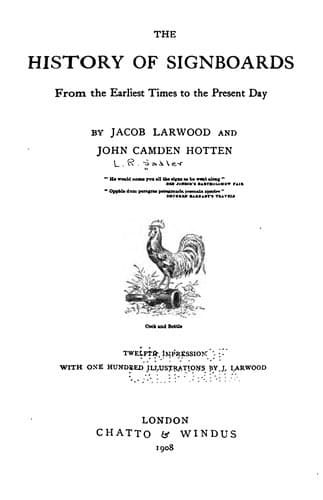
The History of Signboards, from the Earliest times to the Present Day — John Shaqi
The History of Signboards, from the Earliest times to the Present DayHotten, John Camden
History
The History of Signboards, from the Earliest times to the Present Day
Hotten, John Camden
Inn signs -- England -- History; Signs and signboards -- History
“There is nothing like sound literature and good sense to be met with in
those objects, that are everywhere thrusting themselves out to the eye
and endeavouring to become visible. Our streets are filled with _blue
boars_, _black swans_, and _red lions_, not to mention _flying-pigs_
and _hogs in armour_, with many creatures more extraordinary than any in
the deserts of Africa. Strange that one, who has all the birds and
beasts in nature to choose out of, should live at the sign of an _ens
rationis_.
“My first task, therefore, should be like that of Hercules, to clear the
city from monsters. In the second place, I should forbid that creatures
of jarring and incongruous natures should be joined together in the same
sign; such as the _Bell and the Neat’s Tongue_, the _Dog and the
Gridiron_. The _Fox and the Goose_ may be supposed to have met, but what
has the _Fox and the Seven Stars_ to do together? And when did the _Lamb
and Dolphin_ ever meet except upon a signpost? As for the _Cat and
Fiddle_, there is a conceit in it, and therefore I do not intend that
anything I have here said should affect it. I must, however, observe to
you upon this subject, that it is usual for a young tradesman, at his
first setting up, to add to his own sign that of the master whom he
served, as the husband, after marriage, gives a place to his mistress’s
arms in his own coat. This I take to have given rise to many of those
absurdities which are committed over our heads; and, as I am informed,
first occasioned the _Three Nuns and a Hare_, which we see so frequently
joined together. I would therefore establish certain rules for the
determining how far one tradesman may give the sign of another, and in
what case he may be allowed to quarter it with his own.
“In the third place, I would enjoin every shop to make use of a sign
which bears some affinity to the wares in which it deals. What can be
more inconsistent than to see a bawd at the sign of the _Angel_, or a
tailor at the _Lion_? A cook should not live at the _Boot_, nor a
shoemaker at the _Roasted Pig_; and yet, for want of this regulation, I
have seen a _Goat_ set up before the door of a perfumer, and the _French
King’s Head_ at a sword-cutler’s.
“An ingenious foreigner observes that several of those gentlemen who
value themselves upon their families, and overlook such as are bred to
trades, bear the tools of their forefathers in their coats of arms. I
will not examine how true this is in fact; but though it may not be
necessary for posterity thus to set up the sign of their forefathers, I
think it highly proper that those who actually profess the trade should
shew some such mark of it before their doors.
Public-domain text, read in full here on John Shaqi.
Reviews
Reviews
No reviews yet
Be the first to share your thoughts on this work.
Join the Discussion
Join the discussion
Sign in to leave a comment or review.
Sign InorCreate an account