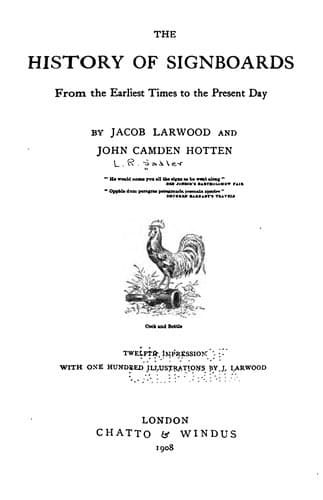
The History of Signboards, from the Earliest times to the Present DayHotten, John Camden
History
The History of Signboards, from the Earliest times to the Present Day
Hotten, John Camden
Inn signs -- England -- History; Signs and signboards -- History
“RICHARD MEARES, Musical Instrument maker, is removed from y’ GOLDEN
VIOL in Leaden Hall Street to y’ North side of St Paul’s Churchyard,
at y’ GOLDEN VIOL AND HAUTBOY, where he sells all sorts of musical
instruments,” &c.--[Bagford bills.]
To increase this complexity still more, came the corruption of names
arising from pronunciation; thus Mr Burn, in his introduction to the
“Beaufoy Tokens,” mentions the sign of Pique and Carreau, on a
gambling-house at Newport, Isle of Wight, which was Englished into the
Pig and Carrot; again, the same sign at Godmanchester was still more
obliterated into the Pig and Checkers. The sign of the Island Queen I
have frequently heard, either in jest or in ignorance, called the
Iceland Queen. The editor of the recently-published “Slang Dictionary”
remarks that he has seen the name of the once popular premier, George
Canning, metamorphosed on an alehouse-sign into the George and Cannon;
so the GOLDEN FARMER became the Jolly Farmer; whilst the Four Alls, in
Whitechapel, were altered into the Four Awls. Along with this practice,
there is a tendency to translate a sign into a sort of jocular slang
phrase; thus, in the seventeenth century, the BLACKMOORSHEAD AND
WOOLPACK, in Pimlico, was called the DEVIL AND BAG OF NAILS by those
that frequented that tavern, and by the last part of that name the house
is still called at the present day. Thus the Elephant and Castle is
vulgarly rendered as the _Pig and Tinderbox_; the Bear and Ragged Staff,
the _Angel and Flute_; the Eagle and Child, the _Bird and Bantling_; the
Hog in Armour, the Pig in Misery; the Pig in the Pound, the _Gentleman
in Trouble_, &c.
Some further information, in illustration of the different signboards,
is to be obtained from the _Adventurer_, No. 9, (1752:)--
“It cannot be doubted but that signs were intended originally to express
the several occupations of their owners, and to bear some affinity in
their external designations with the wares to be disposed of, or the
business carried on within. Hence the Hand and Shears is justly
appropriated to tailors, and the Hand and Pen to writing-masters;
though the very reverend and right worthy order of my neighbours, the
Fleet-parsons, have assumed it to themselves as a mark of ‘marriages
performed without imposition.’ The Woolpack plainly points out to us a
woollen draper; the Naked Boy elegantly reminds us of the necessity of
clothing; and the Golden Fleece figuratively denotes the riches of our
staple commodity; but are not the Hen and Chickens and the Three Pigeons
the unquestionable right of the poulterer, and not to be usurped by the
vender of silk or linen?
Public-domain text, read in full here on John Shaqi.
Reviews
Reviews
No reviews yet
Be the first to share your thoughts on this work.
Join the Discussion
Join the discussion
Sign in to leave a comment or review.
Sign InorCreate an account