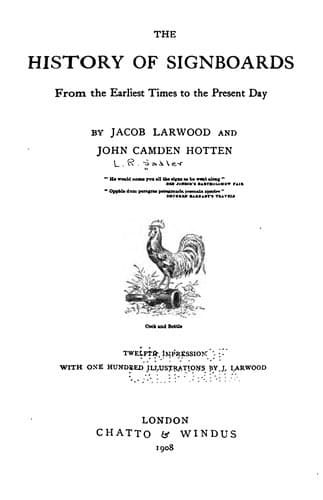
The History of Signboards, from the Earliest times to the Present Day — John Shaqi
The History of Signboards, from the Earliest times to the Present DayHotten, John Camden
History
The History of Signboards, from the Earliest times to the Present Day
Hotten, John Camden
Inn signs -- England -- History; Signs and signboards -- History
“It was certainly from a noble spirit of doing honour to a superior
desert, that our forefathers used to hang out the heads of those who
were particularly eminent in their professions. Hence we see Galen and
Paracelsus exalted before the shops of chemists; and the great names of
Tully, Dryden, and Pope, &c., immortalised on the rubric posts[34] of
booksellers, while their heads denominate the learned repositors of
their works. But I know not whence it happens that publicans have
claimed a right to the physiognomies of kings and heroes, as I cannot
find out, by the most painful researches, that there is any alliance
between them. Lebec, as he was an excellent cook, is the fit
representative of luxury; and Broughton, that renowned athletic
champion, has an indisputable right to put up his own head if he
pleases; but what reason can there be why the glorious Duke William
should draw porter, or the brave Admiral Vernon retail flip? Why must
Queen Anne keep a ginshop, and King Charles inform us of a
skittle-ground? Propriety of character, I think, require that these
illustrious personages should be deposed from their lofty stations, and
I would recommend hereafter that the alderman’s effigy should accompany
his Intire Butt Beer, and that the comely face of that public-spirited
patriot who first reduced the price of punch and raised its reputation
_Pro Bono Publico_, should be set up wherever three penn’orth of warm
rum is to be sold.
“I have been used to consider several signs, for the frequency of which
it is difficult to give any other reason, as so many hieroglyphics with
a hidden meaning, satirising the follies of the people, or conveying
instruction to the passer-by. I am afraid that the stale jest on our
citizens gave rise to so many Horns in public streets; and the number of
Castles floating with the wind was probably designed as a ridicule on
those erected by soaring projectors. Tumbledown Dick, in the borough of
Southwark, is a fine moral on the instability of greatness, and the
consequences of ambition; but there is a most ill-natured sarcasm
against the fair sex exhibited on a sign in Broad Street, St Giles’s, of
a headless female figure called the Good Woman.
‘Quale portentum neque militaris
Daunia in latis alit esculetis,
Nec Jubæ tellus generat, leonum
Arida Nutrix.’--HORACE.
‘No beast of such portentous size
In warlike Daunia’s forest lies,
Nor such the tawny lion reigns
Fierce on his native Afric’s plains.’--FRANCIS.
“A discerning eye may also discover in many of our signs evident marks
of the religion prevalent amongst us before the Reformation. St George,
as the tutelary saint of this nation, may escape the censure of
superstition; but St Dunstan, with his tongs ready to take hold of
Satan’s nose, and the legions of Angels, Nuns, Crosses, and Holy Lambs,
certainly had their origin in the days of Popery.
Public-domain text, read in full here on John Shaqi.
Reviews
Reviews
No reviews yet
Be the first to share your thoughts on this work.
Join the Discussion
Join the discussion
Sign in to leave a comment or review.
Sign InorCreate an account