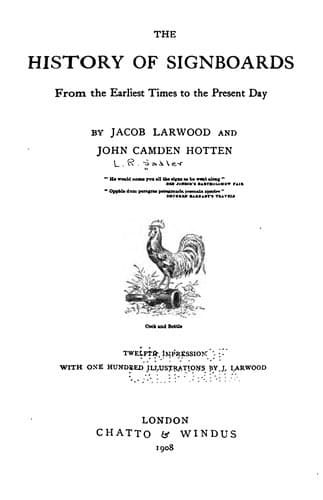
The History of Signboards, from the Earliest times to the Present DayHotten, John Camden
History
The History of Signboards, from the Earliest times to the Present Day
Hotten, John Camden
Inn signs -- England -- History; Signs and signboards -- History
“Among the many signs which are appropriated to some particular
business, and yet have not the least connexion with it, I cannot as yet
find any relation between blue balls and pawnbrokers. Nor could I
conceive the intent of that long pole putting out at the entrance of a
barber’s shop, till a friend of mine, a learned etymologist and
glossariographer, assured me that the use of this pole took its rise
from the corruption of an old English word. ‘It is probable,’ says he,
‘that our primitive tonsors used to stick up a wooden block or head, or
poll, as it was called, before their shop windows, to denote their
occupation; and afterwards, through a confounding of different things
with a like pronunciation, they put up the parti-coloured staff of
enormous length, which is now called a pole, and appropriated to
barbers.’”[35]
The remarks of the _Adventurer_ have brought us down to the middle of
the eighteenth century, when the necessity for signs was not so great as
formerly. Education was spreading fast, and reading had become a very
general acquirement; yet it would appear that the exhibitors of
signboards wished to make up in extravagance what they had lost in use.
“Be it known, however, to posterity,” says a writer in the _Gentleman’s
Magazine_, “that long after signs became unnecessary, it was not unusual
for an opulent shopkeeper to lay out as much upon a sign, and the
curious ironwork with which it was fixed in the house, so as to project
nearly in the middle of the street, as would furnish a less considerable
dealer with a stock in trade. I have been credibly informed that there
were many signs and sign irons upon Ludgate Hill which cost several
hundred pounds, and that as much was laid out by a mercer on the sign of
the Queen’s Head, as would have gone a good way towards decorating the
original for a birthday.” Misson, a French traveller who visited England
in 1719, thus speaks about the signs:--
“By a decree of the police, the signs of Paris must be small, and not
too far advanced from the houses. At London, they are commonly very
large, and jut out so far, that in some narrow streets they touch one
another; nay, and run across almost quite to the other side. They are
generally adorned with carving and gilding; and there are several
that, with the branches of iron which support them, cost above a
hundred guineas. They seldom write upon the signs the name of the
thing represented in it, so that there is no need of Molière’s
inspector. But this does not at all please the German and other
travelling strangers; because, for want of the things being so named,
they have not an opportunity of learning their names in England, as
they stroll along the streets. Out of London, and particularly in
villages, the signs of inns are suspended in the middle of a great
wooden portal, which may be looked upon as a kind of triumphal arch to
the honour of Bacchus.”
Public-domain text, read in full here on John Shaqi.
Reviews
Reviews
No reviews yet
Be the first to share your thoughts on this work.
Join the Discussion
Join the discussion
Sign in to leave a comment or review.
Sign InorCreate an account