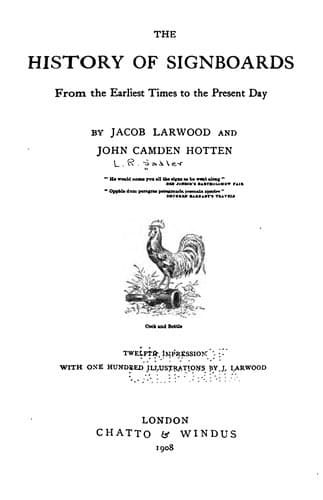
The History of Signboards, from the Earliest times to the Present DayHotten, John Camden
History
The History of Signboards, from the Earliest times to the Present Day
Hotten, John Camden
Inn signs -- England -- History; Signs and signboards -- History
M. Grosley, another Frenchman, who made a voyage through England in
1765, makes very similar remarks. As soon as he landed at Dover, he
observes,--
“I saw nothing remarkable, but the enormous size of the public-house
signs, the ridiculous magnificence of the ornaments with which they
are overcharged, the height of a sort of triumphal arches that support
them, and most of which cross the streets,” &c. Elsewhere he says, “In
fact nothing can be more inconsistent than the choice and the placing
of the ornaments, with which the signposts and the outside of the
shops of the citizens are loaded.”
But gaudy and richly ornamented as they were, it would seem that, after
all, the pictures were bad, and that the absence of inscriptions was not
to be lamented, for those that existed only “made fritters of English.”
The _Tatler_, No. 18, amused his readers at the expense of their
spelling:--“There is an offence I have a thousand times lamented, but
fear I shall never see remedied, which is that, in a nation where
learning is so frequent as in Great Britain, there should be so many
gross errors as there are, in the very direction of things wherein
accuracy is necessary for the conduct of life. This is notoriously
observed by all men of letters when they first come to town, (at which
time they are usually curious that way,) in the inscriptions on
signposts. I have cause to know this matter as well as anybody, for I
have, when I went to Merchant Taylor’s School, suffered stripes for
spelling after the signs I observed in my way; though at the same time,
I must confess, staring at those inscriptions first gave me an idea and
curiosity for medals, in which I have since arrived at some knowledge.
Many a man has lost his way and his dinner, by this general want of
skill in orthography; for, considering that the paintings are usually so
very bad that you cannot know the animal under whose sign you are to
live that day, how must the stranger be misled, if it is wrong spelled
as well as ill painted? I have a cousin now in town, who has answered
under bachelor at Queen’s College, whose name is Humphrey Mopstaff, (he
is akin to us by his mother;) this young man, going to see a relation in
Barbican, wandered a whole day by the mistake of one letter; for it was
written, ‘This is the Beer,’ instead of ‘This is the Bear.’ He was set
right at last by inquiring for the house of a fellow who could not read,
and knew the place mechanically, only by having been often drunk there.
. . . I propose that every tradesman in the city of London and
Westminster shall give me a sixpence a quarter for keeping their signs
in repair as to the grammatical part; and I will take into my house a
Swiss count[36] of my acquaintance, who can remember all their names
without book, for despatch’ sake, setting up the head of the said
foreigner for my sign, the features being strong and fit to hang high.”
Public-domain text, read in full here on John Shaqi.
Reviews
Reviews
No reviews yet
Be the first to share your thoughts on this work.
Join the Discussion
Join the discussion
Sign in to leave a comment or review.
Sign InorCreate an account