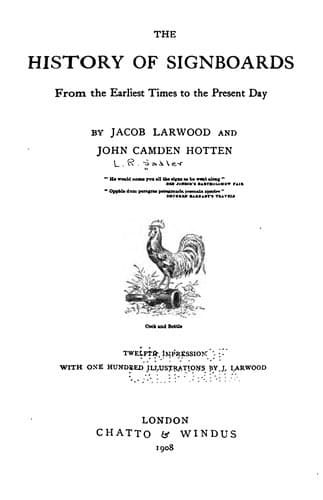
The History of Signboards, from the Earliest times to the Present DayHotten, John Camden
History
The History of Signboards, from the Earliest times to the Present Day
Hotten, John Camden
Inn signs -- England -- History; Signs and signboards -- History
London soon followed: in the _Daily News_, November 1762, we find:--“The
signs in Duke’s Court, St Martin’s Lane, were all taken down and affixed
to the front of the houses.” Thus Westminster had the honour to begin
the innovation, by procuring an act with ample powers to improve the
pavement, &c., of the streets; and this act also sealed the doom of the
signboards, which, as in Paris, were ordered to be affixed to the
houses. This was enforced by a statute of 2 Geo. III. c. 21, enlarged at
various times. Other parishes were longer in making up their mind; but
the great disparity in the appearance of the streets westward from
Temple Bar, and those eastward, at last made the Corporation of London
follow the example, and adopt similar improvements. Suitable powers to
carry out the scheme were soon obtained. In the 6 Geo. III. the Court of
Common Council appointed commissions, and in a few months all the
parishes began to clear away: St Botolph in 1767; St Leonard,
Shoreditch, in 1768; St Martin’s-le-Grand in 1769; and Marylebone in
1770.[38] By these acts--
“The commissioners are empowered to take down and remove all signs or
other emblems used to denote the trade, occupation, or calling of any
person or persons, signposts, signirons, balconies, penthouses,
showboards, spouts, and gutters, projecting into any of the said
streets, &c., and all other encroachments, projections, and annoyances
whatsoever, within the said cities and liberties, and cause the same,
or such parts thereof as they think fit, to be affixed or placed on
the fronts of the houses, shops, warehouses, or buildings to which
they belong, and return to the owner so much as shall not be put up
again or otherwise made use of in such alterations; and any person
having, placing, erecting, or building any sign, signpost, or other
post, signirons, balcony, penthouse, obstruction, or annoyance, is
subject to a penalty of £5, and twenty shillings a day for continuing
the same.”[39]
With the signboards, of course, went the signposts. The removing of the
posts, and paving of the streets with Scotch granite, gave rise to the
following epigram:--
“The Scottish new pavement well deserves our praise;
To the Scotch we’re obliged, too, for mending our ways;
But this we can never forgive, for they say
As that they have taken our posts all away.”
After the signs and posts had been removed, we can imagine how bleak and
empty the streets at first appeared; how silent in the night-time; what
a difficulty there must have been in finding out the houses and shops;
and how everybody, particularly the old people, grumbled about the
innovations.
Public-domain text, read in full here on John Shaqi.
Reviews
Reviews
No reviews yet
Be the first to share your thoughts on this work.
Join the Discussion
Join the discussion
Sign in to leave a comment or review.
Sign InorCreate an account