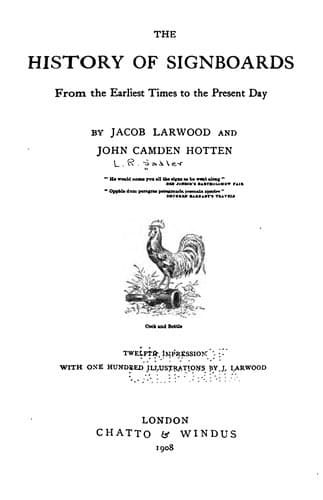
The History of Signboards, from the Earliest times to the Present DayHotten, John Camden
History
The History of Signboards, from the Earliest times to the Present Day
Hotten, John Camden
Inn signs -- England -- History; Signs and signboards -- History
Notwithstanding these innovations, the majority of the old objects still
survive, in name at least, on the signboards of alehouses and taverns.
Their use may still be regarded as a rule with publicans and innkeepers,
although they have become the exception in other trades. Occasionally,
also, we may still come upon a painted signboard, but these are daily
becoming scarcer. Not so in France; there the good old tradition of the
painted signboard is yet kept up. We get a good glimpse of this subject
in the following:[42]--“But it is the signs that so amuse and absolutely
arrest a stranger. This is a practice that has grown into a mania at
Paris, and is even a subject for the ridicule of the stage, since many a
shopkeeper considers his sign as a primary matter, and spends a little
capital in this one outfit. Many of them exhibit figures as large as
life, painted in no humble or shabby style; while history, sacred and
classical, religion, the stage, &c., furnish subjects. You may see the
_Horatii_ and _Curiatii_--a scene from the ‘Fourberies de Scapin’ of
Molière--a group of French soldiers, with the inscription, _A la Valeur
des Soldats Français_, or a group of children inscribed _à la réunion
des Bons Enfants_,[43]--or _à la Baigneuse_, depicting a beautiful nymph
just issuing from the bath; or _à la Somnambule_, a pretty girl walking
in her sleep and nightdress, and followed by her gallant.[44]
“In ludicrous things, a barber will write under his sign:--
‘La Nature donne barbe et cheveux,
Et moi, je les coupe tous les deux.’[45]
‘A toutes les figures dédiant mes rasoirs,
Je nargue la censure des fidèles miroirs.’[46]
“Also a frequent inscription with a barber is, ‘Ici on rajeunit.’ A
breeches-maker writes up, _M----, Culottier de Mme. la Duchesse de
Devonshire_. A _perruquier_ exhibits a sign, very well painted, of an
old fop trying on a new wig, entitled, _Au ci-devant jeune homme_. A
butcher displays a bouquet of faded flowers, with this inscription, _Au
tendre Souvenir_. An eating-house exhibits a punning sign, with an ox
dressed up with bonnet, lace veil, shawl, &c., which naturally implies,
_Bœuf à-la-mode_. A pastry-cook has a very pretty little girl climbing
up to reach some cakes in a cupboard, and this sign he calls, _A la
petite Gourmande_. A stocking-maker has painted for him a lovely
creature, trying on a new stocking, at the same time exhibiting more
charms than the occasion requires to the young fellow who is on his
knees at her feet, with the very significant motto, _A la belle
occasion_.”[47]
Public-domain text, read in full here on John Shaqi.
Reviews
Reviews
No reviews yet
Be the first to share your thoughts on this work.
Join the Discussion
Join the discussion
Sign in to leave a comment or review.
Sign InorCreate an account