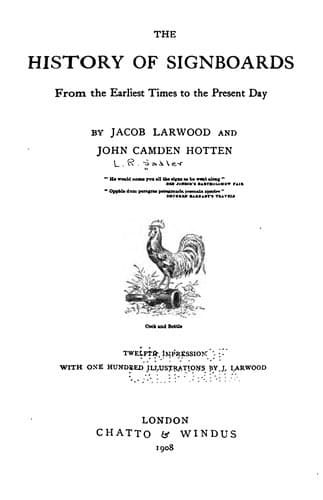
The History of Signboards, from the Earliest times to the Present DayHotten, John Camden
History
The History of Signboards, from the Earliest times to the Present Day
Hotten, John Camden
Inn signs -- England -- History; Signs and signboards -- History
Though it is forty years since these remarks were written, they still,
_mutatis mutandis_, apply to the present day. Even the greatest and most
fashionable shops on the Boulevards have their names or painted signs;
the subjects are mostly taken from the principal topic of conversation
at the time the establishment opened, whether politics, literature, the
drama, or fine arts: thus we have _à la Présidence_; _au Prophète_; _au
Palais d’Industrie_; _aux Enfants d’Edouard_, (the Princes in the
Tower;) _au Colosse de Rhodes_; _à la Tour de Malakoff_; _à la Tour de
Nesles_, (tragedy;) _au Sonneur de St Paul_, (tragedy;) _à la Dame
Blanche_; _à la Bataille de Solferino_; _au Trois Mousquetaires_; _au
Lingot d’Or_, (a great lottery swindle in 1852;) _à la Reine Blanche_,
&c.[48] Some of these signs are remarkably well painted, in a vigorous,
bold style, with great bravura of brush; for instance, _les Noces de
Vulcain_, on the Quai aux Fleurs, is painted in a style which would do
no discredit to the artist of _les Romains de la Décadence_. _Roger
Bontemps_ is still frequent on the French signboard, where he is
represented as a jolly rubicund toper, crowned with vine-leaves and
seated astride a tun, with a brimming tumbler in his hand; this is a
favourite sign with publicans. At the tobacconist’s door we may see a
sign representing an elderly Paul Pry-looking gentleman enjoying a pinch
of snuff. The _Bureaux des Remplacements Militaires_ particularly excel
in a gaudy display of military subjects, where the various passages of a
soldier’s life are represented with all the romance of the warriors of
the comic opera. Here can be seen the gallant troopers now courting
Jeanette or Fanchon; now charging Russians, Cabyles, or Austrians,
according to the date of the picture. Elsewhere a lancer on a fantastic
wild horse; a guide, walking with a pretty _vivandière_, or an old
grenadier with the Legion of Honour upon his breast;--“all the glorious
pomp and circumstance of war” portrayed to entice the French clodhopper
to sell himself “to death or to glory.” More pacific pictures may be
observed at the door of the midwife; there we see a sedate-looking
matron in ecstasy over the interesting young stranger she has just
ushered forth into the world, whilst paterfamilias stands with a
triumphant look in the background. Then there is the Herculean
coalheaver at the door of the _auvergnat_, who sells coals and firewood;
and landscapes with cattle at the dairyshops. But amongst the best
painted are those at the doors of the _marchands de vins et de
comestibles_, where we see frequently bunches of fruit, game, flowers,
glasses, hams, fowls, fish, all cleverly grouped together, and painted
in a dashing style. There is one, for instance, in the Rue Bellechasse,
and another in the Rue St Lazare, that are well worth inspection. These
paintings are generally on the door-posts and window-frames; they are
painted on thin white canvas, fixed with varnish at the back of a thick
Public-domain text, read in full here on John Shaqi.
Reviews
Reviews
No reviews yet
Be the first to share your thoughts on this work.
Join the Discussion
Join the discussion
Sign in to leave a comment or review.
Sign InorCreate an account