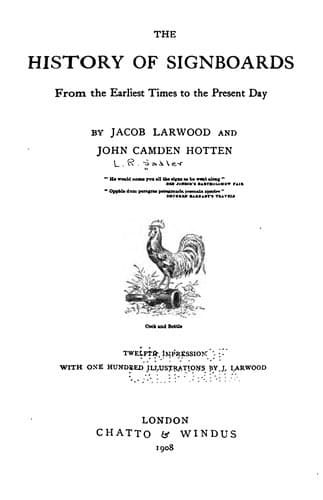
The History of Signboards, from the Earliest times to the Present Day — John Shaqi
The History of Signboards, from the Earliest times to the Present DayHotten, John Camden
History
The History of Signboards, from the Earliest times to the Present Day
Hotten, John Camden
Inn signs -- England -- History; Signs and signboards -- History
[36] Probably John James Heidegger, director of the Opera, a very ugly
man.
[37] For a full account of the “Exhibition,” _see_ in the Supplement at
the end of this work.
[38] The last streets that kept them swinging were Wood Street and
Whitecross Street, where they remained till 1773; whilst in Holywell
Street, Strand, not more than twenty years ago, some were still dangling
above the shop doors. In the suburbs many may be observed even at the
present day.
[39] Laws, Customs, Usages, and Regulations of the City and Port of
London. By Alexander Pulling. London, 1854.
Under the 72d section of the 57 Geo. III. ch. 29, post. 315, Mr
Ballantine, some years ago, decided against a pawnbroker’s sign being
considered a nuisance, notwithstanding it projected over the footway,
unless it obstructed the circulation of light and air, or was
inconvenient or incommodious.
[40] Trades tokens were brass farthings issued by shopkeepers in the
seventeenth century, and stamped with the sign of the shop and the name
of its owner.
[41] Memorials of Nature and Art collected on a Journey in Great Britain
during the Years 1802 and 1803. By C. A. G. Gœde. London, 1808. Vol. i.
p. 68.
[42] Mementos, Historical and Classical, of a Tour through part of
France, Switzerland, and Italy, in the Years 1821 and 1822. London,
1824.
[43] _Un bon enfant_ is in French “a jolly good fellow,” as well as a
“good child.”
[44] Taken from the Opera “La Somnambula.”
[45]
“Nature provides man with hair and beard,
But I cut them both.”
[46]
“I devote my razors to all faces,
And defy the criticism of faithful mirrors.”
[47] A sort of pun, “_la belle occasion_” implying the same idea that
our shopkeepers express by their “Now is your time,” and similar puffs.
[48] Similar instances may also be occasionally met with in London; for
instance, the _Corsican Brothers_, (Coffee-house, Fulham Road.)
[49] Two or three good examples are to be seen in the South Kensington
Museum.
[50] Edwards’s Anecdotes of Painters, 1808, p. 117.
[51] J. T. Smith’s Nollekens and his Times, vol. i. p. 25.
[52] Tommy Burkett was the name of mine host. The painting is now gone,
but the verses remain.
[53] M. A. Lower’s Essay on Family Nomenclature, vol. i. p. 201.
CHAPTER II.
HISTORIC AND COMMEMORATIVE SIGNS.
The Greeks honoured their great men and successful commanders by
erecting statues to them; the Romans rewarded their popular favourites
with triumphal entries and ovations; modern nations make the portraits
of their celebrities serve as signs for public-houses.
“Vernon, the Butcher Cumberland, Wolfe, Hawke,
Prince Ferdinand, Granby, Burgoyne, Keppel, Howe,
Evil and good have had their tithe of talk,
And fill’d their signpost then, like Wellesley now.”
Public-domain text, read in full here on John Shaqi.
Reviews
Reviews
No reviews yet
Be the first to share your thoughts on this work.
Join the Discussion
Join the discussion
Sign in to leave a comment or review.
Sign InorCreate an account