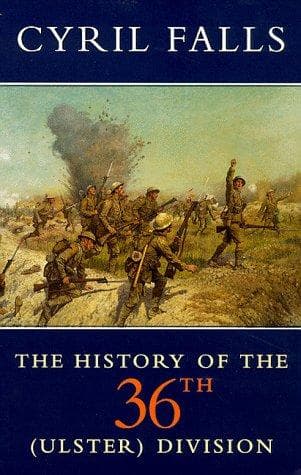
The History of the 36th (Ulster) DivisionFalls, Cyril
History
The History of the 36th (Ulster) Division
Falls, Cyril
Great Britain. Army. Division, 36th; World War, 1914-1918 -- Regimental histories -- Great Britain
The winter, it has already been remarked, was a very wet one. The
health of the troops was generally good, a few cases of that dreadful
disease cerebro-spinal meningitis causing the medical staff its
greatest anxiety. In order, however, to spare the men as far as
possible from strain and discomfort, and to allow those that remained
to be accommodated in the huts as they were completed, some units
were moved out of the camps; the 9th Irish Fusiliers[14] of the 108th
Brigade, and the 11th Inniskillings[14] of the 109th, for example,
moving to barracks, the first to Holywood and Belfast, the second to
the town that gives the regiment its name, Enniskillen. In January
the 109th Brigade, less the 10th Inniskillings, moved to Randalstown.
The 10th Inniskillings remained on the West coast till the first days
of May, suffering the wildest weather in their exposed camp, but
probably no worse than was suffered by the rest of the Brigade in
the first days at Randalstown, which became such a quagmire that men
who slipped from the "duck-boards" between the huts sometimes sank
to their knees in the mud. As weather improved and the hutments were
completed, the full Brigades reassembled in their camps, the 10th
Inniskillings marching across Ireland, from west coast to east, to
rejoin. With the spring there began a new era of intensive training.
Meanwhile had been fought the Marne, the Aisne, the two Battles
of Ypres, Neuve Chapelle. The life in France was impossible to
imagine for those who had not seen it. Not all the marching and
countermarching, the attacks, the trench-digging, the bivouacks,
and cooking of meals in the open could print for the mind's eye an
adequate picture of that. But gradually, through letters, through
the recitals of wounded friends, men began to form some conception
of the realities of modern war, as fought against a race which, for
courage, endurance, and resource, ranked with the most formidable
warrior peoples of the world's history. The gas attack in the Salient
was evidence, if any were still needed, of the temper of the new
Germany. Men did not blanch, but it was inevitable that, to the more
seriously minded among them at least, another and a grimmer picture
than that which had been present with them at the beginning should
form itself. They had answered many calls, chief among them love of
country in various aspects. Mingled with this had been, however, the
spirit of adventure. The old rowel that had driven Ulstermen over
the seas, making them colonists and administrators, was sharpened
again by the war. It pricked on these young men, the flower of their
country. Now, perhaps, the spirit of happy adventure faded a little,
but it was replaced by that of hard resolution and duty. The training
had had its physical results. The troops were strong and supple in
their strength. But it had had a moral result also. The Division was
no longer a mass of men, even of drilled and disciplined men. It had
Public-domain text, read in full here on John Shaqi.
Reviews
Reviews
No reviews yet
Be the first to share your thoughts on this work.
Join the Discussion
Join the discussion
Sign in to leave a comment or review.
Sign InorCreate an account