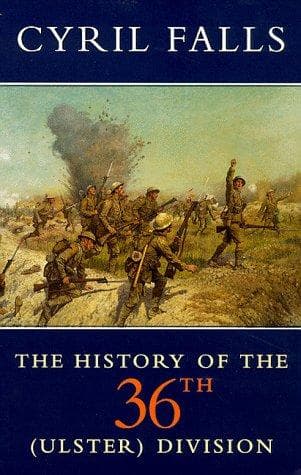
The History of the 36th (Ulster) Division — John Shaqi
The History of the 36th (Ulster) DivisionFalls, Cyril
History
The History of the 36th (Ulster) Division
Falls, Cyril
Great Britain. Army. Division, 36th; World War, 1914-1918 -- Regimental histories -- Great Britain
On November the 27th the Ulster Divisional Artillery, so called at
that date to distinguish it from the London Territorial Artillery,
which was known as the 36th Divisional Artillery, landed at Havre,
and joined the Division in the area east of Abbeville. It had
remained at Bordon since the departure of the Division. Its training
was not yet complete, and it was to have a course of gunnery at
Cayeux, on the coast, south of the mouth of the Somme, before
entering the line. The only other important event, from the military
point of view, to be recorded before February, was the formation of
the 108th and 109th Machine-Gun Companies, from personnel and guns
withdrawn from the battalions. To replace the guns each battalion was
issued with four Lewis guns, which number was gradually increased
till, a year later, it had been quadrupled.
Christmas 1915 was celebrated by the troops in their billets with
sport and festivities. Many units had bought suckling pigs from
the farmers, and fattened them in anticipation of the event; none
had failed to provide some luxuries. The villagers took part in
the merrymaking, and in most of the officers' messes the people of
the house drank with their guests the toast of victory. For very
many of the men in those Somme villages it was one of the happiest
Christmases they had ever spent, and one on which they looked
back in after years with delight. Within a few days the services
of the Pioneers were lost for a long period to the Division. They
were ordered to construct, under the Chief Engineer of the Third
Army, a broad-gauge railway line between Candas and Acheux. For the
rest, there was little change in the daily life of the Division.
On New Year's Day it moved back again to the area about Domart,
roughly that in which it had been previously billeted. The same
work--wood-cutting, repairing and "bunking" of barns, construction
of horse-lines--continued, with the exception that it was done in
different villages. When the work was well in hand some training was
interspersed with it. Not till January the 30th was the Division
ordered to hold itself in readiness to take over a portion of the
line. It had passed the worst of the winter by no means disagreeably.
Public-domain text, read in full here on John Shaqi.
Reviews
Reviews
No reviews yet
Be the first to share your thoughts on this work.
Join the Discussion
Join the discussion
Sign in to leave a comment or review.
Sign InorCreate an account