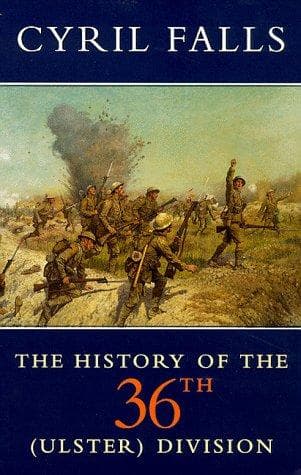
The History of the 36th (Ulster) DivisionFalls, Cyril
History
The History of the 36th (Ulster) Division
Falls, Cyril
Great Britain. Army. Division, 36th; World War, 1914-1918 -- Regimental histories -- Great Britain
The rations arrived each day for all these people in the following
manner: The Divisional Supply Column went daily to railhead with
its lorries to meet the "pack train," bringing up the supplies to
the "refilling point," and dividing them into four groups, one for
each infantry brigade and one for all the rest of the divisional
units. Here, under the supervision of the Brigade Supply Officer, the
supplies were parcelled out, loaded into the horsed supply wagons,
and taken to the transport lines of the units, where they came into
the keeping of the Quartermaster. In a very quiet part of the front,
when the railhead was far advanced, the supply wagons could draw
direct from the railhead, cutting out altogether the Supply Column
and its lorries. Divisions were urged to do this when possible to
save petrol. Let not the innocent, however, imagine that uses were
not found for the lorries thus set at liberty!
The food we need follow no further, except in the case of a
battalion in the trenches. For all other units its preparation was
comparatively simple. But to supply the man on the fire-step with
hot food at regular intervals was a problem of some difficulty.
Rations were brought up to battalion headquarters after dusk by the
transport. In a well-organized battalion--and battalions varied
much in this respect--the maximum was done before the food left
the transport lines, the minimum when it arrived. That minimum
was the heating. In some sectors of the front it used to be said
that cooking was impossible. As a fact, there never was a sector
wherein, with resource and ingenuity, at least the _heating_ of food
already prepared was impracticable. For extras, the stock-pot was the
soldier's best friend; and unhappy was he if his battalion did not
possess it. Ration biscuit, soaked in stock and put through a mincing
machine, made "dough" which produced cheese biscuits, sausage rolls,
jam tarts. As for the dry rations, tobacco, etc., they were put into
a sandbag for each section, labelled with the number of that section.
So, at least, marched affairs in a battalion of which the internal
economy was at a high stage of efficiency.
Public-domain text, read in full here on John Shaqi.
Reviews
Reviews
No reviews yet
Be the first to share your thoughts on this work.
Join the Discussion
Join the discussion
Sign in to leave a comment or review.
Sign InorCreate an account