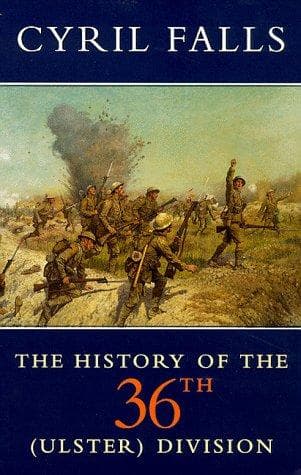
The History of the 36th (Ulster) DivisionFalls, Cyril
History
The History of the 36th (Ulster) Division
Falls, Cyril
Great Britain. Army. Division, 36th; World War, 1914-1918 -- Regimental histories -- Great Britain
The evacuation of wounded may also be briefly described. On a
casualty occurring the wounded man was brought by the regimental
stretcher-bearers to the Regimental Aid Post, a dug-out or shelter
near a communication trench, generally in the neighbourhood of
battalion headquarters. A mile or two further back was the Advanced
Dressing Station, to which the Field Ambulance stretcher-bearers
carried "lying-down" cases and conducted "walking" cases. If
possible, wheeled stretchers or a trench tramway were here employed.
At the A.D.S. food in some form was always ready; wounds were
re-dressed if necessary, morphia given if required, and the soothing
cigarette added. Then the cars of the Field Ambulance conveyed the
casualty to the Main Dressing Station; _i.e._, the headquarters of
the Field Ambulance. This was to all intents and purposes a temporary
hospital, where the wounded man might obtain rest, and further
surgical aid if required. It was the last stage in the divisional
chain. From it the cars of the Motor Ambulance convoy took him to the
Casualty Clearing Station, whence a hospital train bore him to the
base hospital or, during an offensive, direct to the hospital ship.
The above is an attempt to sketch, without entering into its ten
thousand complications, some of the main features of the life of a
man in the trenches. War, at that time and in such a sector as this,
had not acquired many of the horrors that were to come. Bombing
by aeroplanes was in its infancy; so was the use of gas shell.
Long-range shelling of villages with high-velocity guns was almost
unheard of hereabouts. With regard to all shelling there would appear
to have been conventions. Those who have seen German shells at
Mailly-Maillet dropping at dusk, the hour when the transport started
for the line, on to the Serre and Auchonvillers Roads, but never
closer than one hundred yards to the first houses of the village,
will agree with this opinion. The surroundings were far less grisly
and depressing than they afterwards became. There was, it must be
remembered, save that at Ypres and that which at the moment was being
fashioned at Verdun, no devastated area wider than a narrow ribbon
from the coast to Switzerland. From the Mesnil Ridge, where the
observation posts of the Division were manned by the Cyclist Company,
the country behind the enemy's lines showed green and smiling.
Villages which the troops were not to see at close hand save as
ruins, Irles, Pys, Grévillers, Bihucourt, were intact. The time could
be read with the aid of a telescope by the church clock of Bapaume.
On the British side, villages a couple of miles back were little
disturbed. Martinsart was no farther from the enemy, and here it was
possible to call on Brigade headquarters at their château as one
returned from the trenches, and drink a cup of tea poured out by the
daughter of the house, who rang for a British orderly to bring hot
water. Mediæval idyll! With spring appearing, the trenches drying,
Public-domain text, read in full here on John Shaqi.
Reviews
Reviews
No reviews yet
Be the first to share your thoughts on this work.
Join the Discussion
Join the discussion
Sign in to leave a comment or review.
Sign InorCreate an account