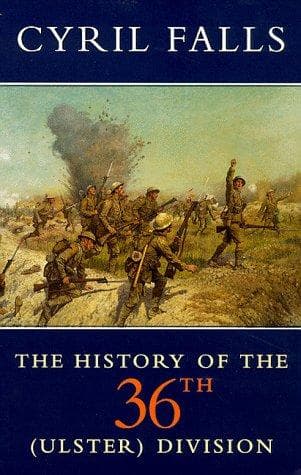
The History of the 36th (Ulster) Division — John Shaqi
The History of the 36th (Ulster) DivisionFalls, Cyril
History
The History of the 36th (Ulster) Division
Falls, Cyril
Great Britain. Army. Division, 36th; World War, 1914-1918 -- Regimental histories -- Great Britain
and the grasses above them filled with field flowers; with the Valley
of the Ancre taking on a new beauty as its trees were feathered
green; with nature bursting into life, man's thoughts could not be
ever fixed upon death. Warfare, to many of the men in the Division,
must have seemed less than terrible in these days. But they were the
last of the good days. The terrible was not far off.
In the first week of March the Division extended its front, the
109th Brigade taking over the sector south of the Ancre, known by
the name of Thiepval Wood. At the same time the 36th Divisional
Artillery, back from its final training at Cayeux, took over the
defence of the long line. By the last day of the month the latter
had been shortened to the two-battalion front astride the Ancre, the
31st Division having come into line on the left. The two sub-sectors
were known as Thiepval Wood and Hamel respectively. The Hamel
sub-sector was comfortable and quiet, troubled by nothing worse than
the aggressions of a new long-range medium trench mortar, which
often smashed in its communication trenches, but seldom caused many
casualties. The battalion which held it was responsible for the
defence of the Ancre and its swampy valley, filled with miniature
lakes. This was carried out by the reserve company in the village,
which found a platoon for small and isolated posts, the most advanced
being at the bridge on the Thiepval-Hamel Road. The men enjoyed this
duty better than any other. They were never shelled, they had no work
to do, and they could employ their leisure fishing in the stream,
with the chance of an occasional shot at wild duck or widgeon.
Thiepval Wood, on the other hand, with an appearance of quietude
that deceived visitors and newcomers, was wont to be transformed by
sudden and not infrequent bombardments into a very unpleasant spot
indeed. It was here that on the 10th of March the 10th Inniskillings
suffered their real baptism of fire. At three in the afternoon there
had been ranging shots from all calibres of artillery upon the wood,
strengthening the belief of the man in the line, which was accepted
with some hesitation by the Staff, that the army opposite possessed
a "travelling circus" of heavy artillery, moved from point to point
for the covering of raids. Precisely at midnight came a roar of
explosions, a whistle and screaming of shells, a crash of falling
trees. All telephone lines were cut, and S.O.S. rockets failed to
ignite, but the artillery soon opened fire on its own initiative. On
the right of the battalion front the trenches were pounded beyond
recognition, and soon littered with dead and wounded. The garrison
of the trenches manned their fire-steps and opened rapid fire on
the enemy's front line. Not till 2 a.m. did the shelling die down.
Then it was found that the enemy had penetrated the trenches of the
troops on the right of the Division, killing a number of officers
and men, and taking several prisoners. In a Special Order of the
Public-domain text, read in full here on John Shaqi.
Reviews
Reviews
No reviews yet
Be the first to share your thoughts on this work.
Join the Discussion
Join the discussion
Sign in to leave a comment or review.
Sign InorCreate an account