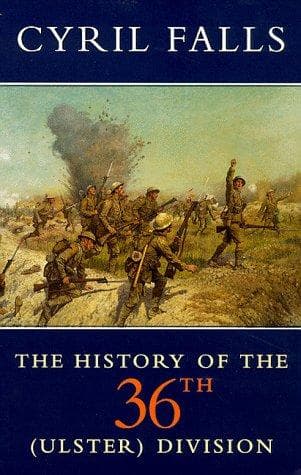
The History of the 36th (Ulster) DivisionFalls, Cyril
History
The History of the 36th (Ulster) Division
Falls, Cyril
Great Britain. Army. Division, 36th; World War, 1914-1918 -- Regimental histories -- Great Britain
Day, congratulating the 10th Inniskillings, the Divisional Commander
stated that "there seemed no reason to doubt that the German
bombardment was intended to cover a raid similar to the raid which
actually took place elsewhere the same night." The battalion had the
further honour of mention in the despatches of Sir Douglas Haig. Its
losses amounted to some thirty killed and wounded.
[Illustration: MAJOR-GENERAL SIR O. S. NUGENT, K.C.B., D.S.O.]
From the moment when the Division first entered the line,
preparations had been made for the long-planned offensive. By the
month of May this work was intensified. It is difficult to give in a
few lines an adequate idea of the scope of such preliminary labour.
The mere plans and instructions issued by the Staffs of the Division,
its formations and units, would fill the greater part of this
volume. There were miles of tramway to be laid, gun-pits for the new
artillery to be constructed, roads to be improved, new communication
trenches cut, and innumerable dug-outs excavated. The heaviest task
of all was the building of two causeways over the Ancre and its
marshes; the only communications with our line on the left bank of
the river being some crazy wooden foot-bridges put up by French
troops. As a first step the drainage of the marshes was examined,
and many obstructions in the small streams removed. The flooded area
was thus decreased, but there were at first frantic protests from
the Division on the right when the water rose behind its lines. This
flooding was, however, but temporary. The construction of these
causeways was entrusted to the 122nd Field Company R.E., which
employed large infantry working parties in two shifts, from dusk to
dawn. The causeways were built of sandbags filled with chalk. The
river was constantly swept at night by machine-gun fire, and the
casualties suffered were not inconsiderable, particularly on the
northern causeway. The mainstay of the whole scheme of preparation
was the Pioneer battalion, which had already made its name by the
construction of the Candas-Acheux railway. It was for this battalion
a proud day when railhead for supplies and personnel opened at Belle
Eglise Farm on the line that was its handiwork. But the whole of the
Division worked with a will also. Tasks were nearly always completed
before the allotted time, for which the sole explanation lay not
entirely in the good hearts of the men, but also in the splendid
physique of the Division at this period.[17] The artillery dug on the
Mesnil Ridge an observation trench known as "Brock's Benefit," in
honour of their General, which contained a whole series of "O.P.s,"
and will be very well remembered by a long series of divisions
subsequently inhabiting that sector.
Public-domain text, read in full here on John Shaqi.
Reviews
Reviews
No reviews yet
Be the first to share your thoughts on this work.
Join the Discussion
Join the discussion
Sign in to leave a comment or review.
Sign InorCreate an account