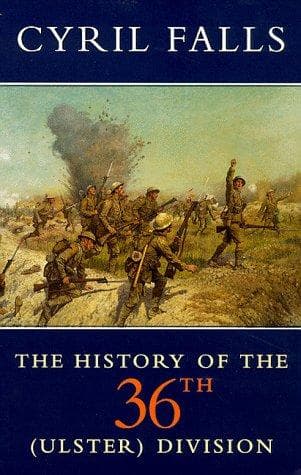
The History of the 36th (Ulster) DivisionFalls, Cyril
History
The History of the 36th (Ulster) Division
Falls, Cyril
Great Britain. Army. Division, 36th; World War, 1914-1918 -- Regimental histories -- Great Britain
The first raid carried out by the Division was on May the 7th, and,
by an extraordinary coincidence, that night was also chosen by the
enemy to raid the troops of the 32nd Division on its right, at a
point about 200 yards west of that of the British raid. The German
barrage opened at 11 p.m.; the British "zero" was midnight. Major
Peacocke,[18] second-in-command of the 9th Inniskillings, had his
party already out in the sunken Thiepval-Hamel Road when the German
bombardment began. He spoke on a telephone which he had taken out
with him to his commanding officer, Colonel Ricardo, and it was
decided to carry through the raid. The British guns, trained on the
barrage lines selected for the raid, held their fire, and a most
uncomfortable hour had to be endured in Thiepval Wood. At midnight
the British barrage opened and the raiders charged in. The enemy was
on the alert, and a fierce struggle followed. The raid was successful
in inflicting heavy casualties on the enemy. No prisoners were taken,
as the Germans in the deep dug-outs showed fight, firing up the
steps. The raiders thereupon bombed the dug-outs till all sounds of
life below had ceased. The casualties were trifling, but there were
a good many more in the sunken road, where the raiding party had to
lie two hours before it could return to its trenches, so heavy was
the German barrage.
Meanwhile, the enemy's intentions with regard to the troops on
the right of the 36th Division being only too clear, six platoons
of the 10th Inniskillings, two from dug-outs on the reverse slope
of Thiepval Wood, and a company from Authuille, moved up to their
support. The former body arrived in the front line of the 1st Dorsets
in time to assist them in repelling the enemy, who left a dead
officer and a wounded prisoner in the hands of the English battalion.
The company from Authuille and two guns of the 109th Machine-Gun
Company also pushed up through a very heavy barrage to the front
line. The Dorsets had suffered very considerable casualties, and
the troops of the Ulster Division assisted to man their line till
morning. The appreciation of the 32nd Division was warmly expressed
by the G.O.C.
In May took place the first reorganization of the Divisional
Artillery, the object of which was to divide the howitzers among
the Brigades, to overcome the disadvantages of which there has been
mention. Three of the Brigades, the 153rd, the 172nd, and the 173rd,
were made up of three four-gun 18-pounder batteries and one four-gun
4.5 howitzer battery. The fourth, the 154th Brigade, which had been
the Howitzer Brigade, thus lost all its howitzer batteries, and was
made up by three 18-pounder batteries, one from each of the other
Brigades, in exchange for the howitzers. Brigade Ammunition Columns
were abolished and the Divisional Ammunition Column largely increased.
Public-domain text, read in full here on John Shaqi.
Reviews
Reviews
No reviews yet
Be the first to share your thoughts on this work.
Join the Discussion
Join the discussion
Sign in to leave a comment or review.
Sign InorCreate an account