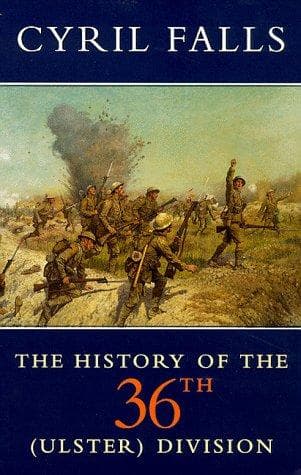
The History of the 36th (Ulster) Division — John Shaqi
The History of the 36th (Ulster) DivisionFalls, Cyril
History
The History of the 36th (Ulster) Division
Falls, Cyril
Great Britain. Army. Division, 36th; World War, 1914-1918 -- Regimental histories -- Great Britain
At the end of May Brigadier-General Hickman, commanding the 109th
Brigade, returned to England, being succeeded by Brigadier-General R.
Shuter, D.S.O. General Hickman, whose part in the formation of the
Division has been recorded, was the last of the Infantry Brigadiers
who had accompanied the Division to France. General Hacket Pain,
commanding the 108th Brigade, had been succeeded by Brigadier-General
C. R. J. Griffith, C.M.G., D.S.O., on December the 4th.
With the month of June began those more detailed preparations for the
offensive which must be reserved for the chapter that deals with it.
By this time all ranks had become aware of what was brewing. A keen
sense of expectation was in the air. The Division had become a living
soul ere ever it crossed the Channel. The months of trench warfare
had strengthened it to an inestimable extent. The men were keyed up
to a very high pitch of daring and determination. The infantry had
the utmost confidence in itself, and in the artillery which was to
support it. Officers and men of these two arms had known each other
but a short time, but already a personal liaison, unusually close, to
grow even closer during the comparatively quiet months in Flanders,
had been established between them. The Division was to do great deeds
in after days, and upon other fields of battle, but never was there
quite the same generous and noble enthusiasm with which it entered
upon this, its first offensive. That which it was about to accomplish
will live in memory as long as there is a British Empire to honour
the exploits of British arms.
FOOTNOTES:
[17] The writer can recall working parties when the allotted task
was completed a full hour before the allotted time, owing to the
fact that the big countrymen of his company were able to carry two
sandbags full of chalk, one in either hand, at once.
[18] Afterwards Lieutenant-Colonel Peacocke, D.S.O., who was foully
murdered at his home near Cork, on June the 1st, 1921.
CHAPTER III
THE BATTLE OF THE SOMME: JULY 1ST, 1916
Public-domain text, read in full here on John Shaqi.
Reviews
Reviews
No reviews yet
Be the first to share your thoughts on this work.
Join the Discussion
Join the discussion
Sign in to leave a comment or review.
Sign InorCreate an account