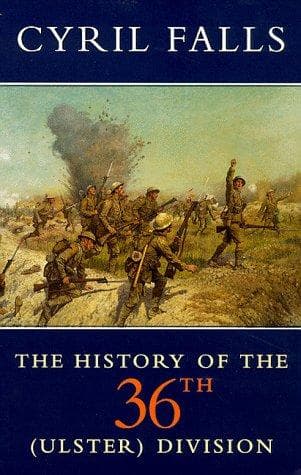
The History of the 36th (Ulster) Division — John Shaqi
The History of the 36th (Ulster) DivisionFalls, Cyril
History
The History of the 36th (Ulster) Division
Falls, Cyril
Great Britain. Army. Division, 36th; World War, 1914-1918 -- Regimental histories -- Great Britain
On the first day of June, 1916, the front of the 36th Division
was held by the 107th Brigade, the 108th being in support in the
neighbourhood of Martinsart, and the 109th training. To permit the
two latter Brigades to train together, the 147th Brigade of the 49th
Division was ordered to relieve the 108th and take over its working
parties. The 108th Brigade then moved back to Varennes, and the
neighbouring villages of Harponville and Léalvillers. Training was
carried out over an elaborate system of dummy trenches marked out
with plough and spade, near Clairfaye Farm, to represent those of the
German system to be attacked. It was largely due to this preparation
that the men knew their task so well, and were able to push on to
their objectives when their leaders had fallen. On the 5th a raid was
carried out by a party of the 12th Rifles, sent up from the training
area, on the German sap that ran parallel with the main railway line
north of the Ancre.[19] The wire was cut by an ammonal torpedo. This
was a zinc tube, three inches in diameter, filled with ammonal. Each
tube was about six feet in length, but tubes could be connected up
with bayonet joints, and any length of torpedo thus made. It was
generally fired by a sapper accompanying the raiding party. The
Germans had run back or taken to their dug-outs under the fire of
our artillery, and few were seen. The dug-outs were bombed, and an
officer shot. Two tunnels leading toward the British lines were
discovered, one containing fourteen high-tension copper wires, which
seemed to point to mining with a mechanical digger. The heads of
these saps were blown in by the engineers who accompanied the raiding
party. Five nights later the Germans retaliated upon the little
salient in the British line opposite, known as the William Redan,
then held by the 15th Rifles. After our trenches had been pounded by
a bombardment of half an hour, the raiders advanced. They suffered
loss from our barrage, and not more than half a dozen ever actually
entered our trench. Half a minute's bitter hand-to-hand fighting,
and they were out of it again, bearing with them the leader of the
raid, who had been shot by a British officer. Our trenches were
considerably damaged, but casualties were not heavy.
Public-domain text, read in full here on John Shaqi.
Reviews
Reviews
No reviews yet
Be the first to share your thoughts on this work.
Join the Discussion
Join the discussion
Sign in to leave a comment or review.
Sign InorCreate an account