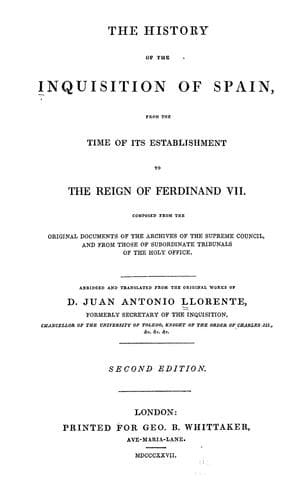
The History of the Inquisition of Spain from the Time of its Establishment to the Reign of Ferdinand VII.Llorente, Juan Antonio
History
The History of the Inquisition of Spain from the Time of its Establishment to the Reign of Ferdinand VII.
Llorente, Juan Antonio
Inquisition -- Spain
It is possible that the church was in a certain degree compelled to act
in this manner, from the impossibility of employing the coercive
measures of temporal power against heretics during the reigns of the
heathen princes; but this was not the only motive for her tolerance,
since it is certain that when no edicts of persecution existed against
the Christians, the emperors received the appeals of the bishops in the
same manner as those of their other subjects: this is proved by the
history of the heretic Paul of Samosata, Bishop of Antioch.
The council of that town, assembled in 272, perceiving that Paul had
relapsed into heresy, after the abjuration which he had made before the
council of 266, deposed him, and elected Domnus in his place. The
episcopal house being still occupied by the deposed bishop, he was
ordered to quit it, that his successor might take possession. Paul
having refused to obey, the bishops applied to the Emperor Aurelian, who
had not then begun to persecute the Christians: he received their
complaint, and replied, that as he did not know which of the two parties
was right, they must conform to the decision of the Bishop of Rome and
his church. The holy see was then occupied by Felix I., who confirmed
the decision of the council, and the Emperor Aurelian caused it to be
executed.
As toleration was universal in the Christian church, it is not to be
supposed that the church of Spain followed different principles.
Basilides and Marcial, Bishops of Astorga and Merida, apostatized; they
were reconciled to the church without any punishment but degradation,
to which they submitted before the year 253, when they appealed to Pope
Stephen.
The Council of Elvira in 303 decreed, that if an heretic demanded to be
re-admitted into the bosom of the church, he should be reconciled,
without suffering any punishment but a canonical penance of ten years,
which was the more remarkable, as this council established more severe
punishments for many crimes which appear less heinous. This seems to
prove that the Spanish bishops who composed this council, among whom
were the great Osius of Cordova, Sabinus of Seville, Valerius of
Saragossa, and Melantius of Toledo, were persuaded, like Origen, that
leniency was the means to convert heretics, in order to prevent them
from falling into obstinacy and impenitence.
SECOND EPOCH.--_From the Fourth to the Eighth Century._
If the primitive system of the church towards heretics had been
faithfully pursued, as it ought to have been, after the peace of
Constantine, the tribunal of the Inquisition would never have existed,
and, perhaps, the number and duration of heresies would have been less;
but the popes and bishops of the fourth century, profiting by the
circumstance of the emperors having embraced Christianity, began to
imitate, in a certain degree, the conduct which they had reprehended in
the heathen priests.
Public-domain text, read in full here on John Shaqi.
Reviews
Reviews
No reviews yet
Be the first to share your thoughts on this work.
Join the Discussion
Join the discussion
Sign in to leave a comment or review.
Sign InorCreate an account