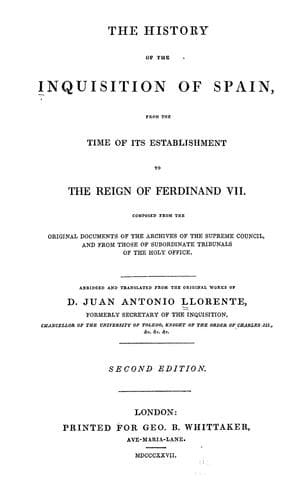
The History of the Inquisition of Spain from the Time of its Establishment to the Reign of Ferdinand VII. — John Shaqi
The History of the Inquisition of Spain from the Time of its Establishment to the Reign of Ferdinand VII.Llorente, Juan Antonio
History
The History of the Inquisition of Spain from the Time of its Establishment to the Reign of Ferdinand VII.
Llorente, Juan Antonio
Inquisition -- Spain
These pontiffs, though respectable for the holiness of their lives,
sometimes carried their zeal for the triumph of the Catholic faith, and
the extirpation of heresy, to too great a height; and to ensure success,
engaged Constantine and his successors to establish civil laws against
all heretics.
This first step, which the popes and bishops had taken contrary to the
doctrine of St. Paul, was the principle and origin of the Inquisition;
for when the custom of punishing a heretic by corporeal pain, although
he was a good subject, was once established, it became necessary to vary
the punishments, to augment their number, to render them more or less
severe, according to the character of each sovereign, and to regulate
the manner of prosecuting the culprit.
The Emperor Theodosius published, in 382, an edict against the
Manicheans, decreeing that they should be punished with death, and their
property confiscated for the use of the state, and commissioning the
prefect (Préfet du Prétoire) to appoint inquisitors and spies to
discover those who should conceal themselves.
It is here that inquisition and accusation are first mentioned in
relation to heresy, for until that time only those great crimes which
attacked the safety of the empire were permitted to be publicly
denounced. The successors of Theodosius modified these edicts, some of
which menaced heretics with the prosecutions of the impartial judges, if
they did not voluntarily abjure their errors. Notices were given to
known heretics who did not abjure after the publication of the edicts,
that if they were converted in a certain time, they would be admitted to
a reconciliation, and would only suffer a canonical penance.
When these conciliatory measures were unavailing, various punishments
were adopted. Those doctors who, in contempt of the laws, promulgated
their false opinions, were subjected to considerable fines, banishment
from cities, and even transportation. In certain cases, their property
was confiscated; in others they were obliged to pay a fine of ten pounds
of gold, or they were scourged with leathern thongs, and sent to islands
from whence they could not escape. Besides these punishments, they were
forbidden to hold assemblies, and the offenders were liable to
proscription, banishment, transportation, and even death in some cases.
The execution of these decrees was intrusted to the governors of
provinces, magistrates charged with the administration of justice,
commanders of towns and their principal officers, who were all liable to
various punishments in case of negligence.
The establishment of most of these laws had been solicited by popes and
bishops of known sanctity, and it must be allowed that it was not their
intention to carry those which decreed the punishment of death into
execution; they only desired to intimidate innovators by their
publication.
Public-domain text, read in full here on John Shaqi.
Reviews
Reviews
No reviews yet
Be the first to share your thoughts on this work.
Join the Discussion
Join the discussion
Sign in to leave a comment or review.
Sign InorCreate an account