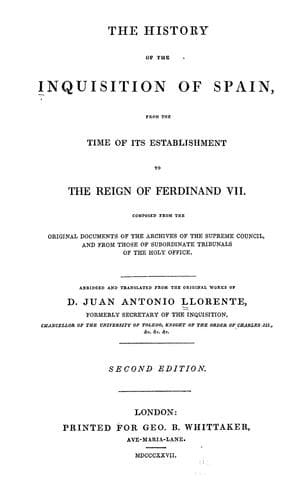
The History of the Inquisition of Spain from the Time of its Establishment to the Reign of Ferdinand VII.Llorente, Juan Antonio
History
The History of the Inquisition of Spain from the Time of its Establishment to the Reign of Ferdinand VII.
Llorente, Juan Antonio
Inquisition -- Spain
The church of Spain continued faithful to the general discipline, under
the authority of the Roman emperors; the Arian heresy was afterwards
established among them under the Goths; but since their princes have
embraced the Catholic faith, the laws and councils of Spain inform us of
their treatment of heretics.
The fourth Council of Toledo, assembled in 633, at which St. Isidore,
Archbishop of Seville, assisted, was occupied with the Judaic heresy: it
was decreed, with the consent of King Sisinand, that they should be at
the disposal of the bishops, to be punished, and compelled by fear to
return to Christianity a second time: they were to be deprived of their
children, and their slaves set at liberty.
In 655, the ninth Council of Toledo decreed, that baptized Jews should
be obliged to celebrate the Christian festivals with their bishops, and
that those who should refuse to conform to this discipline should be
condemned either to the punishment of scourging, or abstinence,
according to the age of the offender.
We find that greater severity was shown towards those who returned from
Christianity to idolatry. King Récarede I. proposed to the third Council
of Toledo, in 589, that the priests and civil judges should be
commissioned to extirpate that species of heresy, by punishing the
culprits in a degree proportioned to the crime, yet without employing
capital punishment.
These rigorous measures did not appear sufficient, and the twelfth
Council of Toledo, in 681, at which King Erbigius assisted, decided
that, if the offender was noble, he should be subject to excommunication
and exile; if he was a slave, he should be scourged and delivered to his
master loaded with chains, and if the proprietor could not answer for
him, that he should be placed at the disposal of the king.
In 693, the sixteenth Council of Toledo assembled in the presence of
King Egica, added, to the measures already established, a law, by which
all who opposed the efforts of the bishops and judges to destroy
idolatry were condemned, if noble, to be excommunicated and pay a fine
of three pounds of gold; and if of a low condition, to receive a hundred
strokes of a whip, and have half his property confiscated.
Recesuinte, who reigned from 663 to 672, established a particular law
against heretics: it deprived them indiscriminately of the wealth and
dignities they might possess, if they were priests, and added to these
punishments, perpetual banishment for laymen, if they persisted in
heresy.
THIRD EPOCH.--_From the Eighth Century to the Pontificate of Gregory
VII._
Public-domain text, read in full here on John Shaqi.
Reviews
Reviews
No reviews yet
Be the first to share your thoughts on this work.
Join the Discussion
Join the discussion
Sign in to leave a comment or review.
Sign InorCreate an account