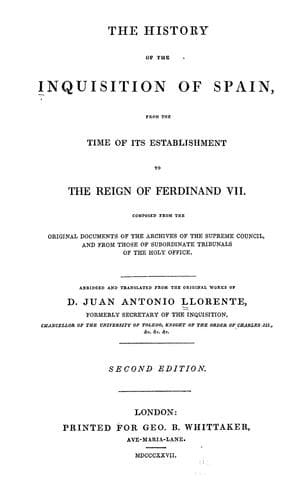
The History of the Inquisition of Spain from the Time of its Establishment to the Reign of Ferdinand VII.Llorente, Juan Antonio
History
The History of the Inquisition of Spain from the Time of its Establishment to the Reign of Ferdinand VII.
Llorente, Juan Antonio
Inquisition -- Spain
Peter and Ralph commenced preaching against the heretics; they held
conferences with these fanatics, but the number of the converted was
very small. Arnauld, Abbot of the Cistercians, called upon twelve abbots
of his order to assist him; and (during their sojourn at Montpellier)
they admitted two Spaniards to share their labours, who were known under
the names of Diego Acebes, a bishop of Osma, who was returning to his
diocese, and St. Dominic de Guzman, a regular canon of the order of St.
Augustine. They both converted several Albigenses, and when the Spanish
bishop returned to his diocese, he permitted St. Dominic to remain in
France.
The great feudal chiefs of Provence and Narbonne refused to execute the
orders of the legates, to pursue the heretics in their states, alleging
that they were always at war with each other; but the legates threatened
to excommunicate them, and to release their subjects from their oaths of
fidelity. These menaces alarmed the nobles, and they consented to sign a
peace.
The most powerful of these princes was Raymond VI., Count of Toulouse.
His conduct towards Peter de Castelnau, who had threatened him several
times for not performing his promises, induced the Albigenses who were
his subjects to assassinate the legate, who was beatified in 1208. The
pope wrote to all the nobles of the provinces of Narbonne, Arles,
Embrun, Aix, and Vienne in Dauphiny, pressing them to unite and march
against the heretics, and promising them the same indulgences which had
been granted to the crusaders.
The assassination of Peter de Castelnau had excited among the Catholics
the greatest indignation against his murderers. Arnauld took advantage
of this moment to execute the orders which he had received from the
pope. He commissioned the twelve monks, and others whom he had
associated, to preach a crusade against the heretics, to grant
indulgences, to note those who refused to engage in the war, to inform
themselves of their creed, to reconcile the converted, and place all
obstinate heretics at the disposal of Simon de Montfort, commander of
the crusaders. This was the beginning of the Inquisition in 1208.
Pope Innocent III. died on the 16th of July, 1216, before he had
succeeded in giving a permanent form to the delegated inquisition: the
continuation of the war against the Albigenses, and the opposition which
he met with from the bishops in the Council of Lateran, were perhaps the
causes of his failure. Honorius III., who succeeded him, prepared to
finish his undertaking.
Innocent had sent St. Dominic de Guzman to Toulouse, that he might
choose one of the religious orders approved by the church, for the
institution which he intended to form. He preferred that of St.
Augustine; and on his return to Rome with his companions, Honorius
approved his choice on the 22nd of December, 1216.
Public-domain text, read in full here on John Shaqi.
Reviews
Reviews
No reviews yet
Be the first to share your thoughts on this work.
Join the Discussion
Join the discussion
Sign in to leave a comment or review.
Sign InorCreate an account