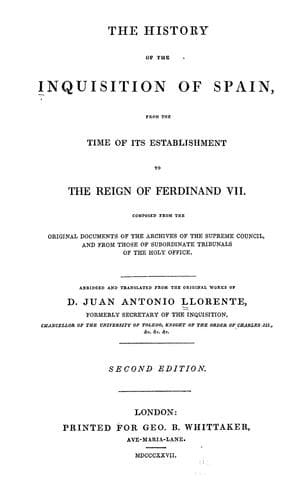
The History of the Inquisition of Spain from the Time of its Establishment to the Reign of Ferdinand VII.Llorente, Juan Antonio
History
The History of the Inquisition of Spain from the Time of its Establishment to the Reign of Ferdinand VII.
Llorente, Juan Antonio
Inquisition -- Spain
St. Dominic also established an order for laymen. This order has been
designated as the _Third Order of Penitence_, but most commonly as the
_Militia of Christ_, because those who were members of it fought against
heretics, and assisted the Inquisitors in the exercise of their
functions; they were considered as part of the inquisitorial family, and
on that account bore the name of _Familiars_. This association
afterwards gave rise to that which was called the _Congregation of St.
Peter Martyr_; it was approved by Honorius, and confirmed by his
successor, Gregory IX. Another association was formed in Narbonne, which
also bore the name of _Militia of Christ_; it was soon after blended
with the third order of St. Dominic. Honorius having formed a
constitution against heretics, the Emperor Frederic II. gave it the
sanction of civil law at his coronation. In 1224 the Inquisition already
existed in Italy under the ministry of the Dominican friars, which is
proved by an edict of the Emperor Frederic against heretics at Padua.
The efforts of the Inquisition in Narbonne had not succeeded according
to the expectation of the pope, who imputed its failure to the
negligence of Cardinal Conrad, whom he recalled, and sent Cardinal Roman
in his place. The importunity of this legate induced Louis VIII., King
of France, to place himself at the head of an army to march against the
nobles who protected the Albigenses. But Louis died in the same year,
and the pope followed him, without having succeeded in giving a
permanent form to the new tribunal which had been introduced into
France.
Gregory IX., who ascended the pontifical throne in 1227, finally
established the Inquisition: he had been the zealous protector of St.
Dominic, and the intimate friend of St. Francis d'Assiz. Cardinal Roman
was more fortunate than the legates who preceded him: the nobles, weary
of a war which had lasted twenty years, wished for peace. The Count of
Toulouse, Raymond VII., after the death of his father, who had begun the
war, reconciled himself to St. Louis and the church in a Council of
Narbonne, and promised to drive the heretics from his domains.
In 1229 another council was held at Toulouse. The decrees were nearly
the same as those made at the Councils of Lateran and Verona, except
that laymen were then first prohibited from reading the Scriptures in
the vulgar tongue. In the succeeding year, many other edicts were
published, increasing in severity; but it appears that these rigorous
measures failed in effect, as the heresy of the Albigenses penetrated
even to the capital of Christendom.
CHAPTER III.
OF THE ANCIENT INQUISITION OF SPAIN.
Public-domain text, read in full here on John Shaqi.
Reviews
Reviews
No reviews yet
Be the first to share your thoughts on this work.
Join the Discussion
Join the discussion
Sign in to leave a comment or review.
Sign InorCreate an account