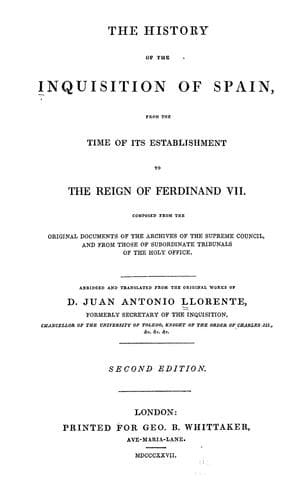
The History of the Inquisition of Spain from the Time of its Establishment to the Reign of Ferdinand VII.Llorente, Juan Antonio
History
The History of the Inquisition of Spain from the Time of its Establishment to the Reign of Ferdinand VII.
Llorente, Juan Antonio
Inquisition -- Spain
In 1233, when the Inquisition in France had received the established
form which was bestowed on it by St. Louis, Spain was divided into four
Christian kingdoms, besides the Mahometan states. Castile was under the
dominion of St. Ferdinand, who added to it the kingdoms of Seville,
Cordova, and Jaen. James I. governed Aragon, and conquered the kingdoms
of Valencia and Majorca; Navarre was possessed by Sancho VIII., who died
in the course of the following year, and left his crown to Theobald I.,
Count de Champagne and de Brie. Sancho II. reigned in Portugal.
Many convents of Dominicans existed in these kingdoms after the
establishment of the order, but there are no authentic records, to prove
that the Inquisition was introduced before the year 1232, when Pope
Gregory IX. addressed a brief to Don Esparrago, Archbishop of Taragona,
and to his suffragan bishops, in which he most earnestly exhorted them
to oppose the progress of heresy by every means in their power.
The archbishop sent the bull to Gil Rodriguez de Valladares, first
provincial of the Spanish Dominicans; he also sent it to Don Bertrand,
Bishop of Lerida, in whose diocese the first Spanish Inquisition was
founded. Pope Innocent VI. conferred many privileges on the Dominican
Friars, and in 1254 extended the rights of the Inquisitors, and in the
same brief decreed that the depositions of witnesses should be
considered valid, although their names were unknown. Urban VI. and
Clement VI. also augmented their privileges.
The Kings of Aragon continued to protect the Inquisition, and James II.,
in 1292, published a decree, commanding the tribunals of justice to
assist the Dominicans, to imprison all who might be denounced, to
execute the judgments pronounced by the monks, to remove every obstacle
which they might meet with, _&c_. The hatred which the office of an
inquisitor everywhere inspired in the first ages of the Inquisition
caused the death of a great number of Dominicans and some Cordeliers:
the honours of martyrdom were assigned to them, but St. Peter of Verona
was the only one canonized by the pope. Nothing certain is known of the
state of Portugal during this period: it appears that in the thirteenth
century the Inquisition was established only in the dioceses of
Taragona, Barcelona, Urgel, Lerida, and Girona.
The convents of Dominicans having multiplied in Spain, a chapter-general
of the order decreed, in 1301, that it should be divided into two
provinces; that the first in rank should be named the province of Spain,
and comprise Castile and Portugal; and that the second should have the
title of Aragon, and be composed of Valencia, Catalonia, Rousillon,
Cerdagne, Majorca, Minorca, and Iviza.
The provincial of the Dominicans of Castile, designated as the
provincial of Spain, possessed the right of naming the apostolical
inquisitor in the other provinces. In 1302 Father Bernard was inquisitor
of Aragon, and celebrated several _autos-da-fé_ in the same year.
Public-domain text, read in full here on John Shaqi.
Reviews
Reviews
No reviews yet
Be the first to share your thoughts on this work.
Join the Discussion
Join the discussion
Sign in to leave a comment or review.
Sign InorCreate an account