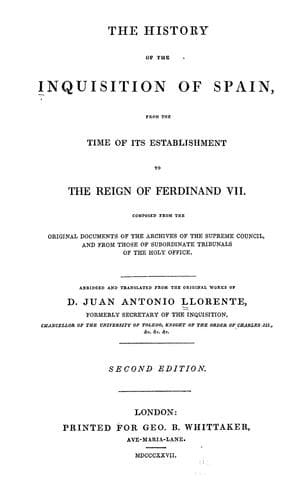
The History of the Inquisition of Spain from the Time of its Establishment to the Reign of Ferdinand VII. — John Shaqi
The History of the Inquisition of Spain from the Time of its Establishment to the Reign of Ferdinand VII.Llorente, Juan Antonio
History
The History of the Inquisition of Spain from the Time of its Establishment to the Reign of Ferdinand VII.
Llorente, Juan Antonio
Inquisition -- Spain
In 1308 Pope Clement V. commanded the King of Aragon and the inquisitors
to arrest all the knights templars who had not been prosecuted, and to
confiscate their property for the use of the holy see; the templars in
Castile and Portugal were also arrested.
In 1314, other heretics were discovered in the kingdom of Aragon;
Bernard Puigceros, the inquisitor-general, condemned several to
banishment, the others were burnt. Many who abjured were reconciled.
In 1325, F. Arnaldo Burguete, inquisitor-general of the kingdom,
arrested Pierre Durand de Baldhac, who had relapsed into heresy, and he
was burnt alive in the presence of King James, his sons, and two
bishops.
In 1334, F. William da Costa condemned F. Bonato to the flames, and
reconciled many persons who had been perverted by that monk.
In 1350, Father Nicholas Roselli discovered a sect of heretics named
_Begards_, whose chief was named Jacobus Justis; they were all
reconciled, and Jacobus was condemned to perpetual imprisonment. The
bones of three of these heretics who had died impenitent were
disinterred and burnt. Roselli being elected Cardinal in 1356, Nicholas
Eymerich succeeded him. Eymerich composed a book entitled "The Guide of
Inquisitors," in which the most minute details of his judgments, and
those of other inquisitors of Aragon, are found.
It is not certain whether the provincial of Castile exercised his
privilege of naming inquisitors; perhaps heresy had not penetrated into
the states of Castile.
Pope Gregory IX. dying in 1378, the Romans named Urban VI. as his
successor; but several cardinals assembled out of Rome, and elected
another Pope under the name of Clement VII.
The great schism of the West then began, and lasted till the election of
Martin V., in the Council-general of Constance in 1417, where Don Gil
Muñoz, who had been elected as Clement VIII., renounced the papacy. This
revolution influenced the state of the Inquisition as much as the other
points of ecclesiastical discipline. Castile followed the party of
Clement VII., and Portugal that of Urban VI. The order of Dominicans was
equally divided, and elected different vicars-general. Urban VI. died in
1389, and his party elected Boniface IX., who appointed F. Rodrigo de
Cintra apostolical inquisitor-general of Portugal. He afterwards named
F. Vicente de Lisboa inquisitor-general of Spain. Castile, Navarre, and
Aragon were under the dominion of Benedict XIII., who was elected Pope
after the death of Clement VII. Such was the state of the Inquisition in
Spain towards the end of the fourteenth century.
Public-domain text, read in full here on John Shaqi.
Reviews
Reviews
No reviews yet
Be the first to share your thoughts on this work.
Join the Discussion
Join the discussion
Sign in to leave a comment or review.
Sign InorCreate an account