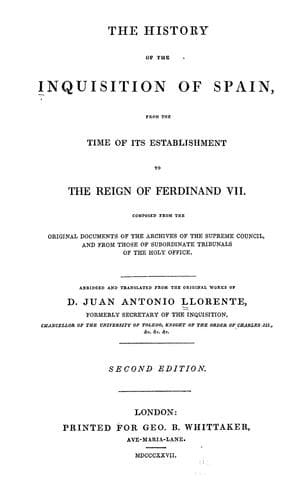
The History of the Inquisition of Spain from the Time of its Establishment to the Reign of Ferdinand VII.Llorente, Juan Antonio
History
The History of the Inquisition of Spain from the Time of its Establishment to the Reign of Ferdinand VII.
Llorente, Juan Antonio
Inquisition -- Spain
It is uncertain if the Inquisition existed in Castile in the beginning
of the fifteenth century; for, though Boniface IX. appointed F. Vicente
de Lisboa inquisitor-general, his authority was not recognized, as that
kingdom belonged to the party of Benedict XIII., who, after the Council
of Constance, was designated as the anti-pope Peter de Luna. The town of
Perpignan was the seat of one of the provincial Inquisitions of Aragon,
whose jurisdiction extended over the countships of Rousillon and
Cerdagne, and over the islands of Majorca, Minorca, and Iviza. Benedict
XIII., who was recognized in this part of Spain, divided this province
and appointed two inquisitors, who celebrated several _autos-da-fé_, and
burnt a considerable number of people.
The election of Martin V. having put an end to the great schism of the
West, the Portuguese monks ought to have submitted to the authority of
the Provincial of Spain, who was then a monk of their nation, named F.
Juan de Santa Justa; but the Dominicans who were at Constance persuaded
the Pope that his jurisdiction was too extensive, which induced the
pontiff to subdivide the province of Spain into three parts: the first
part was named the province of Spain, and comprised Castile, Toledo,
Murcia, Estremadura, Andalusia, Biscay, and the Asturias de Santillana;
the second, Santiago, was composed of the kingdom of Leon, Galicia, and
the Asturias of Oviedo; and the third, that of Portugal, extended over
all the dominions of the monarch.
Martin V. established a provincial Inquisition at Valencia, in 1420, at
the request of Alphonso V., King of Aragon; hitherto commissioners had
only been sent there.
The Inquisitor of Aragon, 1441, was F. Michael Ferriz, and that of
Valencia, F. Martin Trilles, who reconciled in their districts several
Wickliffites, and condemned many others to be burnt. Several inquisitors
succeeded these till 1474, when Isabella, wife of Ferdinand of Aragon,
King of Sicily, ascended the throne of Castile, after the death of Henry
IV. her brother. John II., King of Aragon, dying in 1479, his son,
Ferdinand, united that kingdom to Sicily; he soon after conquered the
kingdom of Grenada, which belonged to the Moors, and lastly that of
Navarre, which was secured to him by the capitulation of the
inhabitants.
CHAPTER IV.
OF THE GOVERNMENT OF THE OLD INQUISITION.
Public-domain text, read in full here on John Shaqi.
Reviews
Reviews
No reviews yet
Be the first to share your thoughts on this work.
Join the Discussion
Join the discussion
Sign in to leave a comment or review.
Sign InorCreate an account