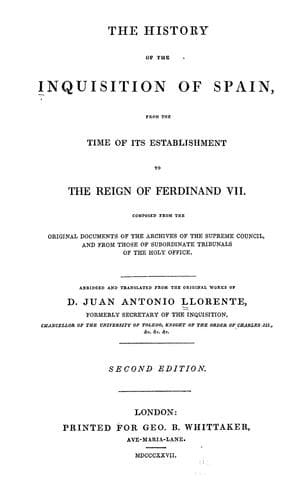
The History of the Inquisition of Spain from the Time of its Establishment to the Reign of Ferdinand VII.Llorente, Juan Antonio
History
The History of the Inquisition of Spain from the Time of its Establishment to the Reign of Ferdinand VII.
Llorente, Juan Antonio
Inquisition -- Spain
Although the Popes, in establishing the Inquisition, had only proposed
to punish the crime of heresy, yet the inquisitors were commissioned to
pursue those Christians who were only suspected, because it was the only
means of discovering those who were really guilty. There were many
crimes which came under the jurisdiction of a civil judge, which the
Popes considered no one could be guilty of without being tainted with a
false doctrine; and although they were pursued by secular tribunals, the
inquisitors were enjoined to consider the accused as suspected of
heresy, and to proceed against them, in order to ascertain if they
committed these crimes from the depravity natural to man, or from the
idea that they were not criminal; which opinion caused a suspicion that
their doctrine was erroneous. A species of blasphemy which was called
heretical, belonged to this class of crimes; it was committed against
God or his saints, and showed in the offender erroneous opinions of the
omniscience or other attributes of the Deity. It rendered the blasphemer
liable to be suspected of heresy, as the inquisitor might consider it a
proof that his habitual thoughts were contrary to the faith.
The second species of crime which caused a suspicion of heresy, was
sorcery and divination. If the offenders only made use of natural and
simple means of discovering the future, such as counting the lines in
the palm of the hand, they came under the jurisdiction of a civil judge;
but all sorcerers were liable to be punished for heresy by the
Inquisition, if they baptized a dead person, re-baptized an infant, made
use of holy water, the consecrated host, the oil of extreme unction, or
other things which proved contempt or abuse of the sacraments and the
mysteries of religion.
The same suspicion affected those who addressed themselves to demons in
their superstitious practices. A third species of crime was the
invocation of demons. Nicholas Eymerich informs us that, in his office
of inquisitor, he had procured and burnt, after having read them, two
books which treated of that subject; they both contained an account of
the power of demons, and of the mode of worshipping them. The same
author adds, that in his time a great number of trials for this crime
took place in Catalonia, and that many of the accused had gone so far as
to worship Satan, with all the signs, ceremonies, and words of the
Catholic religion.
A fourth kind of crime which caused suspicion of heresy, was, to remain
a year, or longer, excommunicated without seeking absolution, or
performing the penance which had been imposed. The Popes affirmed that
no Catholic, irreproachable in his faith, could live with so much
indifference under the censure of the church.
Public-domain text, read in full here on John Shaqi.
Reviews
Reviews
No reviews yet
Be the first to share your thoughts on this work.
Join the Discussion
Join the discussion
Sign in to leave a comment or review.
Sign InorCreate an account