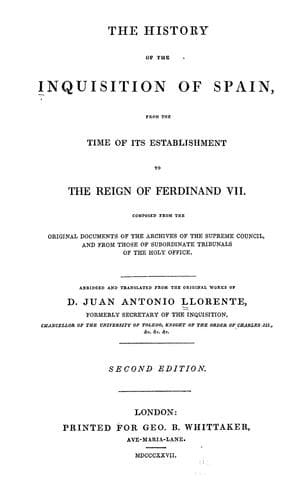
The History of the Inquisition of Spain from the Time of its Establishment to the Reign of Ferdinand VII.Llorente, Juan Antonio
History
The History of the Inquisition of Spain from the Time of its Establishment to the Reign of Ferdinand VII.
Llorente, Juan Antonio
Inquisition -- Spain
Schism was the sixth case where heresy was suspected. It may exist
either without heresy or with it. To the first class belong all
schismatics, who admit the articles of the faith, but deny the authority
of the Pope, as head of the Catholic Church, and vicar of Jesus Christ.
The second is composed of those who hold the same opinions as the first,
and also refuse to believe in some of the articles; such as the Greeks,
who hold that the Holy Ghost proceeds only from the Father, and not from
the Son.
The Inquisition also proceeded against concealers, favourers, and
adherents of heretics, as being suspected of professing the same
opinions. The seventh class was composed of all those who opposed the
Inquisition, and prevented the inquisitors from exercising their
functions.
The eighth class comprehended those nobles who refused to take an oath
to drive the heretics from their states. The ninth class consisted of
governors of kingdoms, provinces and towns, who did not defend the
Church against heretics, when they were required by the Inquisition. The
tenth class comprised those who refused to repeal the statutes in force
in towns and cities, when they were contrary to the measures decreed by
the holy office. The eleventh class of suspected persons, were all
lawyers, notaries, and other persons belonging to the law, who assisted
heretics by their advice; or concealed papers, records, and other
writings, which might make their errors, dwellings, or stations known.
In the twelfth class of suspected were those persons who have given
ecclesiastical sepulture to known heretics. Those who refused to take an
oath in the trials of heretics when they were required to do it, were
also liable to suspicion. The fourteenth class were deceased persons who
had been denounced as heretics. The Popes, in order to render heresy
more odious, had decreed that the bodies of dead heretics should be
disinterred and burnt, their property confiscated, and their memory
pronounced infamous. The same suspicion fell upon writings which
contained heretical doctrines, or which might lead to them. Lastly, the
Jews and Moors were considered as subject to the holy office, when they
engaged Catholics to embrace their faith, either by their writings or
discourse.
Although all the persons guilty of the crimes above-mentioned were under
the jurisdiction of the holy office, yet the Pope, his legates, his
nuncios, his officers, and familiars were exempt; and if any of these
were denounced as heretics, the inquisitor could only take the secret
information and refer it to the Pope. Bishops were also exempt, but
kings had not that privilege.
Public-domain text, read in full here on John Shaqi.
Reviews
Reviews
No reviews yet
Be the first to share your thoughts on this work.
Join the Discussion
Join the discussion
Sign in to leave a comment or review.
Sign InorCreate an account