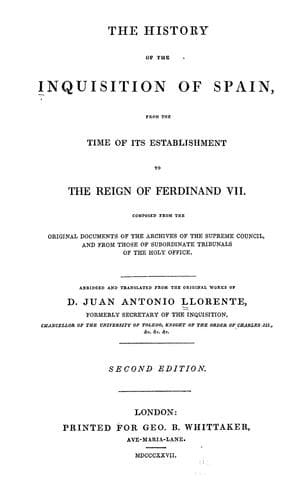
The History of the Inquisition of Spain from the Time of its Establishment to the Reign of Ferdinand VII.Llorente, Juan Antonio
History
The History of the Inquisition of Spain from the Time of its Establishment to the Reign of Ferdinand VII.
Llorente, Juan Antonio
Inquisition -- Spain
As the bishops were the ordinary inquisitors by divine right, it seems
just that they should have had the power of receiving informations, and
proceeding against the apostolical inquisitors in matters of faith; but
the Pope rendered his delegates independent, by decreeing that none but
an apostolical inquisitor could proceed against another. The inquisitor
and the bishop acted together, but each had the right of pursuing
heretics separately: the orders for imprisonment could only be issued by
both together, and if they did not accord they referred to the Pope. The
inquisitors could require the assistance of secular power in the
exercise of their authority, and it could not be refused without
incurring the punishment of excommunication and suspicion of heresy. The
bishop was obliged to lend his house for the prisoners; besides this,
the inquisitors had a particular prison to secure the persons of the
accused.
The first inquisitors had no fixed salary: the holy office was founded
on devotion and zeal for the faith; its members were almost all monks,
who had made a vow of poverty, and the priests who were associated in
their labours, were generally canons, or provided with benefices. But
when the inquisitors began to make journeys, accompanied by recorders,
alguazils, and an armed force, the Pope decreed that all their expenses
should be defrayed by the bishops, on the pretence that the inquisitors
laboured for the destruction of heresy in their dioceses. This measure
displeased the bishops, still more as they were deprived of part of
their authority. The expenses of the Inquisition were afterwards
defrayed by the fines and confiscations of the condemned heretics: these
resources were the only funds of the holy office; it never possessed any
fixed revenue.
_Of the Manner of Proceeding in the Tribunals of the Old Inquisition._
When a priest was appointed an inquisitor by the Pope, or by a delegate
of the holy see, he wrote to the king, who issued a royal mandate to all
the tribunals of the towns where the inquisitor would pass to perform
his office, commanding them, on pain of the most severe penalties, to
arrest all the persons whom he should mark as heretics, or suspect of
heresy, and to execute the judgments passed upon them. The same order
obliged the magistrates to furnish the inquisitor and his attendants
with a lodging, and to protect them from insult and every inconvenience.
When the inquisitor arrived at the town where he intended to enter upon
his office, he officially informed the magistrate, and required his
attendance, fixing the time and place.
Public-domain text, read in full here on John Shaqi.
Reviews
Reviews
No reviews yet
Be the first to share your thoughts on this work.
Join the Discussion
Join the discussion
Sign in to leave a comment or review.
Sign InorCreate an account