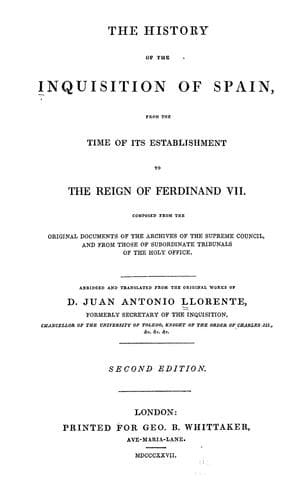
The History of the Inquisition of Spain from the Time of its Establishment to the Reign of Ferdinand VII. — John Shaqi
The History of the Inquisition of Spain from the Time of its Establishment to the Reign of Ferdinand VII.Llorente, Juan Antonio
History
The History of the Inquisition of Spain from the Time of its Establishment to the Reign of Ferdinand VII.
Llorente, Juan Antonio
Inquisition -- Spain
The commander of the town presented himself before the delegate, and
took an oath to put in force all the laws against heretics. If the
officer or magistrate refused to obey, the inquisitor excommunicated
him; if he made no difficulty, the inquisitor appointed a day for the
people to meet in the church, when he preached, and read an edict which
commanded that all informations should be given within a certain
period. The inquisitor afterwards declared that all who should
voluntarily confess themselves heretics, should receive absolution, and
be subjected to a slight penance, but that those who were denounced
should be proceeded against with severity.
If any accusations took place during the interval, they were registered,
but did not take effect until it was known that the accused would not
come voluntarily before the tribunal. After the expiration of the period
allowed, the informer was summoned; he was told that there were three
ways of proceeding to discover the truth,--accusation, information, and
inquisition, and was asked to which he gave the preference. If he chose
the first, he was invited to accuse the denounced person, but at the
same time to consider that he was subject to the law of retaliation if
he was found to be a calumniator. This manner of proceeding was adopted
by very few persons: the greater number declared, that fear of the
punishments with which the holy office menaced those who did not inform
against heretics was the cause of their appearance; and they desired
that their information might be kept secret, on account of the danger
they incurred of being assassinated if they were known.
The inquisitor interrogated the witnesses, assisted by the recorder and
two priests, who were commissioned to observe if the declarations were
faithfully taken down, and to be present when they were read to the
witnesses, who were then asked if they acknowledged all that was read to
them. If the crime or suspicion of heresy was proved in the information,
the criminal was arrested and taken to the ecclesiastical prison. After
his arrest, he was examined, and his answers compared with the testimony
of the witnesses. If the accused confessed himself guilty of one heresy,
it was in vain for him to assert that he was innocent of the others; he
was not permitted to defend himself, because his crime was proved. He
was asked if he would abjure the heresy of which he acknowledged himself
guilty. If he consented, he was reconciled, and the canonical penance
was imposed on him, with some other punishment; if he refused, he was
declared an obstinate heretic, and was delivered up to secular justice,
with a copy of his sentence.
If the accused denied the charge, and undertook to defend himself, a
copy of the process was given to him, but without the names of the
accuser or the witnesses, and with every circumstance omitted which
might lead to their discovery.
Public-domain text, read in full here on John Shaqi.
Reviews
Reviews
No reviews yet
Be the first to share your thoughts on this work.
Join the Discussion
Join the discussion
Sign in to leave a comment or review.
Sign InorCreate an account