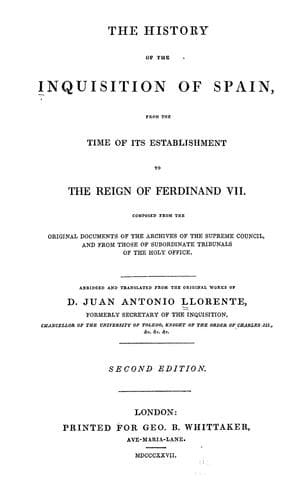
The History of the Inquisition of Spain from the Time of its Establishment to the Reign of Ferdinand VII.Llorente, Juan Antonio
History
The History of the Inquisition of Spain from the Time of its Establishment to the Reign of Ferdinand VII.
Llorente, Juan Antonio
Inquisition -- Spain
The accused was asked if he had enemies, and if he knew their motives
for hating him. He was also permitted to declare that he suspected any
particular person of wishing to ruin him. In either case the proof was
admitted, and the inquisitor considered it in passing judgment. The
inquisitor sometimes asked the accused if he knew certain persons; these
individuals were the accusers and witnesses; if he replied in the
negative, he could not afterwards challenge them as enemies: in the
course of time, every one concluded that these persons were the accuser
and the witnesses, and the custom was abandoned. The accused person was
also permitted to appeal to the Pope, who rejected or admitted his
appeal, according to the rules of justice. There was no regular
proceeding before the Inquisition, and the judges did not fix a time to
establish the proof of the facts. After the replies and defence of the
accused, the inquisitor and the bishop of the diocese, or their
delegates, proceeded to pass sentence without any other formalities. If
the accused denied the charges, although he was convicted or strongly
suspected, he was tortured, to force him to confess his crime; or if it
was thought that there was no necessity for it, the judges proceeded to
pass the final sentence.
If the crime imputed to the accused was not proved, he was acquitted,
and a copy of the declaration given to him, but the name of his accuser
was not communicated. If he had been calumniated, he was obliged to
clear himself publicly by the canonical method, in the town where it had
taken place; he afterwards abjured all heresy, and received the
absolution _ad cautelam_[2] for all the censures which he had incurred.
In order to proportion the punishment to the suspicion, it was divided
into three degrees, named _slight_, _serious_, and _violent_.
The person who was declared to be suspected, though in the least degree,
was called upon to renounce all heresies, and particularly that of which
he was suspected. If he consented, he was reconciled, and was subjected
to punishments and penances; if he refused, he was excommunicated; and
if he did not demand absolution, or promise to abjure after the space of
one year, he was considered as an obstinate heretic, and proceeded
against as such. If the accused was a _formal_ heretic, willing to
abjure, and not guilty of having relapsed, he was reconciled with
penances.
Public-domain text, read in full here on John Shaqi.
Reviews
Reviews
No reviews yet
Be the first to share your thoughts on this work.
Join the Discussion
Join the discussion
Sign in to leave a comment or review.
Sign InorCreate an account