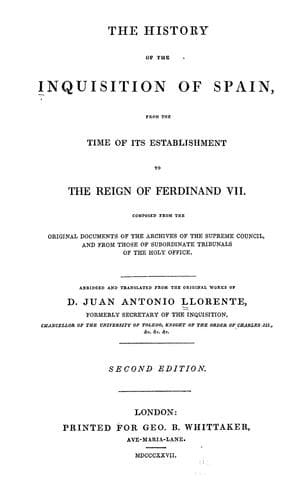
The History of the Inquisition of Spain from the Time of its Establishment to the Reign of Ferdinand VII.Llorente, Juan Antonio
History
The History of the Inquisition of Spain from the Time of its Establishment to the Reign of Ferdinand VII.
Llorente, Juan Antonio
Inquisition -- Spain
When Sixtus IV. received this letter he had just learnt that his bulls
had met with some resistance in Sicily from the viceroy and other
magistrates, and artfully took advantage of Isabella's request to
confirm his authority in that kingdom. He replied to the queen, and
praised her zeal for the Inquisition; appeased her scruples of
conscience in regard to the confiscations; and assured her that he would
have complied with all her demands, if the cardinals, and those charged
with the administration of affairs, had not found insurmountable
difficulties in so doing. He exhorted her to maintain the Inquisition in
her states, and above all to take proper measures that the apostolical
bulls should be received and executed in Sicily.
The councillors to whom the Pope had submitted the demands of Isabella,
approved of the creation of an apostolical judge of appeal in Spain; and
proposed at the same time that no person descended from the Jews, either
by the male or female side, should be admitted among the inquisitorial
judges. Don Inigo Manrique was named sole judge of appeals in all
matters of faith.
CHAPTER VI.
CREATION OF A GRAND INQUISITOR-GENERAL; OF A ROYAL COUNCIL OF THE
INQUISITION; OF SUBALTERN TRIBUNALS AND ORGANIC LAWS: ESTABLISHMENT OF
THE HOLY OFFICE IN ARAGON.
In 1483, Father Thomas de Torquemada was appointed inquisitor-general of
Aragon, and the immense powers of his office were confirmed in 1486, by
Innocent VIII. and by the two successors of that pontiff. It would have
been impossible to find a man more proper to fulfil the intentions of
Ferdinand in multiplying the number of confiscations than Torquemada. He
first created four inferior tribunals at Seville, Cordova, Jaen, and
Villa-Real (now Ciudad-Real); the latter was soon after transferred to
Toledo. He then permitted the Dominican fathers to exercise their
functions in the kingdom of Castile: these monks, who held their
commission from the holy see, did not submit to the authority of
Torquemada without some resistance; they declared that they were not his
delegates. Torquemada did not pronounce their deposition, as he feared
it would injure the execution of the enterprise which he was commencing,
but prepared to form laws which he found very necessary. He chose as
assistants and councillors, two Civilians, named John Gutierrez de
Chabes, and Tristan de Medina. At this time Ferdinand, perceiving how
important it was to the interest of the revenue to organize the
tribunal, created a royal council of the Inquisition, and appointed
Torquemada president, and as councillors, Don Alphonso Carillo, Bishop
of Mazara in Sicily, Sancho Velasquez de Cuellar and Ponce de Valencia,
both doctors of law. Torquemada commissioned his two assistants to
arrange the laws for the new council, and convoked a junta, which was
composed of the inquisitors of the four tribunals which he had
established, the two assistants, and the members of the royal council.
Public-domain text, read in full here on John Shaqi.
Reviews
Reviews
No reviews yet
Be the first to share your thoughts on this work.
Join the Discussion
Join the discussion
Sign in to leave a comment or review.
Sign InorCreate an account