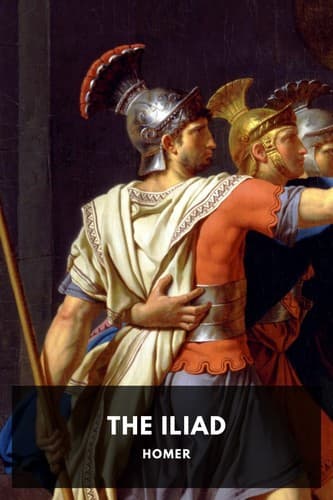
Achilles (Mythological character); Epic poetry, Greek -- Translations into English; Trojan War
Footnote 6: (return) The old mistake of construing ἀντιόωσαν
“sharing,” which still clings to the translations, is exploded by
Buttm. Lex. p. 144. Eust. and Heysch. both give εὺτρεπίζονσαν as one of
the interpretations; and that such is the right one is evident from the
collateral phrase πορσύνειν λέχος in Od. iii. 403. Λμφιζέζηκας is the
perfect tense, but with the force of the present.
Thus he spoke; but the old man was afraid, and obeyed the command. And
he went in silence along the shore of the loud-resounding sea; but
then, going apart, the aged man prayed much to king Apollo, whom
fair-haired Latona bore:
“Hear me, god of the silver bow, who art wont to protect Chrysa and
divine Cilla, and who mightily rulest over Tenedos: O Sminthius, 7 if
ever I have roofed 8 thy graceful temple, or if, moreover, at any time
I have burned to thee the fat thighs of bulls or of goats, accomplish
this entreaty for me. Let the Greeks pay for my tears, by thy arrows.”
Footnote 7: (return) An epithet derived from σμίνθος, the Phrygian
name for a _mouse_: either because Apollo had put an end to a plague of
mice among that people, or because a mouse was thought emblematical of
augury.—Grote, Hist. of Greece, vol. i. p. 68, observes that this
“worship of Sminthian Apollo, in various parts of the Troad and its
neighbouring territory, dates before the earliest period of Æolic
colonization.” On the Homeric description of Apollo, see Müller,
Dorians, vol. i. p. 315.
Footnote 8: (return) Not “crowned,” as Heyne says; for this was a
later custom.—See Anthon and Arnold.
Thus he spoke praying; but to him Phoebus Apollo hearkened. And he
descended from the summits of Olympus, enraged in heart, having upon
his shoulders his bow and quiver covered on all sides. But as he moved,
the shafts rattled forthwith 9 upon the shoulders of him enraged; but
he went along like unto the night. Then he sat down apart from the
ships, and sent among them an arrow, and terrible arose the clang of
the silver bow. First he attacked the mules, and the swift 10 dogs; but
afterwards despatching a pointed arrow against [the Greeks] themselves,
he smote them, and frequent funeral-piles of the dead were continually
burning. Nine days through the army went the arrows of the god; but on
the tenth, Achilles called the people to an assembly; for to his mind
the white-armed goddess Juno had suggested it; for she was anxious
concerning the Greeks, because she saw them perishing. But when they
accordingly were assembled, and were met together, swift-footed
Achilles, rising up amidst them, [thus] spoke:
Public-domain text, read in full here on John Shaqi.
Reviews
Reviews
No reviews yet
Be the first to share your thoughts on this work.
Join the Discussion
Join the discussion
Sign in to leave a comment or review.
Sign InorCreate an account