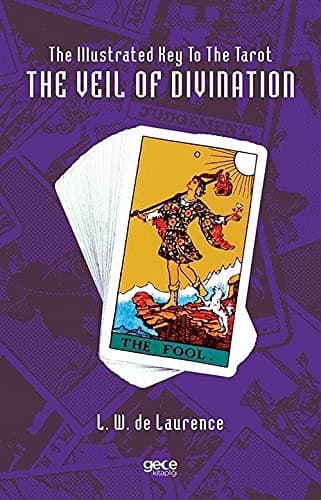
The Illustrated Key to the Tarot: The Veil of DivinationDe Laurence, L. W. (Lauron William)
Religion
The Illustrated Key to the Tarot: The Veil of Divination
De Laurence, L. W. (Lauron William)
Fortune-telling by cards; Tarot
counsel is that a man must not spare himself even in the
presence of death, but he must be certain that his sacrifice shall be—of
any open course—the best that will ensure his end. The
axiom is that the strength which is raised to such a degree that a
man dares lose himself shall show him how Nature (God) is
found, and as to such refuge—dare therefore and learn. (d)
Prudence is the economy which follows the line of least resistance,
that the soul may get back whence it came. It is a doctrine of
divine parsimony and conservation of energy because of the stress,
the terror and the manifest impertinences of this life. The corresponding
counsel is that true prudence is concerned with the one
thing needful, and the axiom is: Waste not, want not. The conclusion
of the whole matter is a business proposition founded on
the law of exchange: You cannot help getting what you seek in
respect of the things that are Divine: it is the law of supply and
demand. I have mentioned these few matters at this point for two
simple reasons: (a) because in proportion to the impartiality of
the mind it seems sometimes more difficult to determine whether it
is vice or vulgarity which lays waste the present world more piteously;
(b) because in order to remedy the imperfections of the old
notions it is highly needful, on occasion, to empty terms and
phrases of their accepted significance, that they may receive a
new and more adequate meaning.
10. The Wheel of Fortune. There is a current Manual of
Cartomancy which has obtained a considerable vogue in England,
and amidst a great scattermeal of curious things to no purpose has
intersected a few serious subjects. In its last and largest edition
it treats in one section of the Tarot; which—if I interpret the
author rightly—it regards from beginning to end as the Wheel
of Fortune, this expression being understood in my own sense. I
have no objection to such an inclusive though conventional description;
it obtains in all the worlds, and I wonder that it has not
been adopted previously as the most appropriate name on the side
of common fortune-telling. It is also the title of one of the
Trumps Major—that indeed of our concern at the moment, as my
sub-title shows. Of recent years this has suffered many fantastic
presentations and one hypothetical reconstruction which is suggestive
in its symbolism. The wheel has seven radii; in the eighteenth
century the ascending and descending animals were really
of nondescript character, one of them having a human head. At
the summit was another monster with the body of an indeterminate
beast, wings on shoulders and a crown on head. It carried
two wands in its claws. These are replaced in the reconstruction
by a Hermanubis rising with the wheel, a Sphinx
couchant at the summit and a Typhon on the descending side.
Here is another instance of an invention in support of a hypothesis;
but if the latter be set aside the grouping is symbolically
correct and can pass as such.
Public-domain text, read in full here on John Shaqi.
Reviews
Reviews
No reviews yet
Be the first to share your thoughts on this work.
Join the Discussion
Join the discussion
Sign in to leave a comment or review.
Sign InorCreate an account