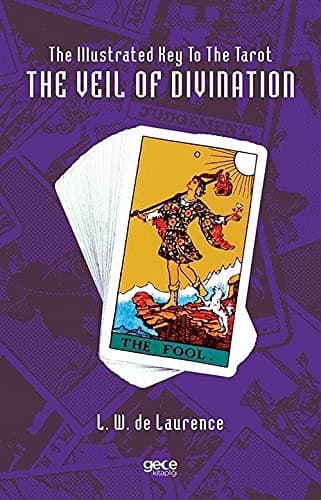
The Illustrated Key to the Tarot: The Veil of DivinationDe Laurence, L. W. (Lauron William)
Religion
The Illustrated Key to the Tarot: The Veil of Divination
De Laurence, L. W. (Lauron William)
Fortune-telling by cards; Tarot
8. Fortitude. This is one of the cardinal virtues, of which I
shall speak later. The female figure is usually represented as
closing the mouth of a lion. In the earlier form which is
printed by Court de Gebelin, she is obviously opening it. The
first alternative is better symbolically, but either is an instance
of strength in its conventional understanding, and conveys the
idea of mastery. It has been said that the figure represents
organic force, moral force and the principle of all force.
9. The Hermit, as he is termed in common parlance, stands
next on the list; he is also the Capuchin, and in more philosophical
language the Sage. He is said to be in search of that Truth
which is located far off in the sequence, and of Justice which
has preceded him on the way. But this is a card of attainment,
as we shall see later, rather than a card of quest. It is said also
that his lantern contains the Light of Occult Science and that
his staff is a Magic Wand. These interpretations are comparable
in every respect to the divinatory and fortune-telling meanings
with which I shall have to deal in their turn. The diabolism of
both is that they are true after their own manner, but that they
miss all the high things to which the Greater Arcana should be
allocated. It is as if a man who knows in his heart that all roads
lead to the heights, and that God (Nature) is at the great height
of all, should choose the way of perdition or the way of folly as
the path of his own attainment. Eliphas Lévi has allocated this
card to Prudence, but in so doing he has been actuated by the
wish to fill a gap which would otherwise occur in the symbolism.
The four cardinal virtues are necessary to an idealogical sequence
like the Trumps Major, but they must not be taken only in that
first sense which exists for the use and consolation of him who
in these days of halfpenny journalism is called the man in the
street. In their proper understanding they are the correlatives of
the counsels of perfection when these have been similarly re-expressed,
and they read as follows: (a) Transcendental Justice,
the counter-equilibrium of the scales, when they have been over-weighted
so that they dip heavily on the side of God (Nature).
The corresponding counsel is to use loaded dice when you play
for high stakes with Diabolus. The axiom is Aut Deus, aut nihil.
(b) Divine Ecstasy, as a counterpoise to something called Temperance,
the sign of which is, I believe, the extinction of lights in
the tavern. The corresponding counsel is to drink only of new
wine in the Kingdom of the Father, because God (Nature) is all
in all. The axiom is that man being a reasonable being must get
intoxicated with God (Nature); the imputed case in point is
Spinoza. (c) The state of Royal Fortitude, which is the state of
a Tower of Ivory and a House of Gold, but it is God (Nature)
and not the man who has become Turris fortitudinis a facie inimici,
and out of that House the enemy has been cast. The corresponding
Public-domain text, read in full here on John Shaqi.
Reviews
Reviews
No reviews yet
Be the first to share your thoughts on this work.
Join the Discussion
Join the discussion
Sign in to leave a comment or review.
Sign InorCreate an account