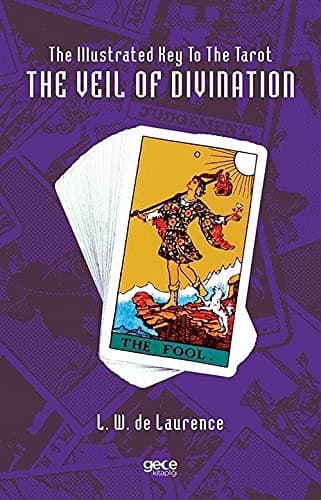
The Illustrated Key to the Tarot: The Veil of DivinationDe Laurence, L. W. (Lauron William)
Religion
The Illustrated Key to the Tarot: The Veil of Divination
De Laurence, L. W. (Lauron William)
Fortune-telling by cards; Tarot
11. Justice. That the Tarot, though it is of all reasonable antiquity,
is not of time immemorial, is shown by this card, which
could have been presented in a much more archaic manner.
Those, however, who have gifts of discernment in matters of this
kind will not need to be told that age is in no sense of the essence
of the consideration; the Rite of Closing the Lodge in the Third
Craft Grade of Masonry may belong to the late eighteenth century,
but the fact signifies nothing; it is still the summary of all
the instituted and official Mysteries. The female figure of the
eleventh card is said to be Astræa, who personified the same
virtue and is represented by the same symbols. This goddess notwithstanding,
and notwithstanding the vulgarian Cupid, the
Tarot is not of Roman mythology, or of Greek either. Its presentation
of Justice is supposed to be one of the four cardinal
virtues included in the sequence of Greater Arcana; but, as it so
happens, fourth emblem is wanting, and it became necessary for
the commentators to discover it at all costs. They did what it was
possible to do, and yet the laws of research have never succeeded
in extricating the missing Persephone under the form of Prudence.
Court de Gebelin attempted to solve the difficulty by a
tour de force, and believed that he had extracted what he wanted
from the symbol of the Hanged Man—wherein he deceived himself.
The Tarot has, therefore, its Justice, its Temperance also
and its Fortitude, but—owing to a curious omission—it does not
offer us any type of Prudence, though it may be admitted that, in
some respects, the isolation of the Hermit, pursuing a solitary
path by the light of his own lamp, gives, to those who can receive
it, a certain high counsel in respect of the via prudentiæ.
12. The Hanged Man. This is the symbol which is supposed
to represent Prudence, and Eliphas Lévi says, in his most shallow
and plausible manner, that it is the adept bound by his engagements.
The figure of a man is suspended head-downwards from
a gibbet, to which he is attached by a rope about one of his ankles.
The arms are bound behind him and one leg is crossed over the
other. According to another, and indeed the prevailing interpretation,
he signifies sacrifice, but all current meanings attributed
to this card are cartomancists' intuitions, apart from any real
value, on the symbolical side. The fortune-tellers of the eighteenth
century who circulated Tarots, depict a semi-feminine
youth in jerkin, poised erect on one foot and loosely attached to
a short stake driven into the ground.
Public-domain text, read in full here on John Shaqi.
Reviews
Reviews
No reviews yet
Be the first to share your thoughts on this work.
Join the Discussion
Join the discussion
Sign in to leave a comment or review.
Sign InorCreate an account