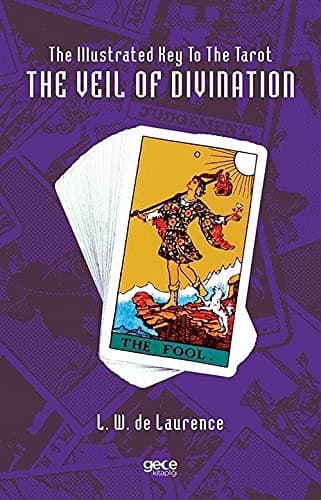
The Illustrated Key to the Tarot: The Veil of Divination — John Shaqi
The Illustrated Key to the Tarot: The Veil of DivinationDe Laurence, L. W. (Lauron William)
Religion
The Illustrated Key to the Tarot: The Veil of Divination
De Laurence, L. W. (Lauron William)
Fortune-telling by cards; Tarot
13. Death. The method of presentation is almost invariable,
and embodies a bourgeois form of symbolism. The scene is the
field of life, and amidst ordinary rank vegetation there are living
arms and heads protruding from the ground. One of the heads is
crowned, and a skeleton with a great scythe is in the act of mowing
it. The transparent and unescapable meaning is death, but
the alternatives allocated to the symbol are change and transformation.
Other heads have been swept from their place previously,
but it is, in its current and patent meaning, more
especially a card of the death of Kings. In the exotic sense it has
been said to signify the ascent of the spirit in the divine spheres,
creation and destruction, perpetual movement, and so forth.
14. Temperance. The winged figure of a female—who, in opposition
to all doctrine concerning the hierarchy of angels, is usually
allocated to this order of ministering spirits—is pouring liquid
from one pitcher to another. In his last work on the Tarot, Dr.
Papus abandons the traditional form and depicts a woman wearing
an Egyptian head-dress. The first thing which seems clear
on the surface is that the entire symbol has no especial connection
with Temperance, and the fact that this designation has always
obtained for the card offers a very obvious instance of a meaning
behind meaning, which is the title in chief to consideration in respect
of the Tarot as a whole.
15. The Devil. In the eighteenth century this card seems to
have been rather a symbol of merely animal impudicity. Except
for a fantastic head-dress, the chief figure is entirely naked; it has
bat-like wings, and the hands and feet are represented by the
claws of a bird. In the right hand there is a scepter terminating in
a sign which has been thought to represent fire. The figure as a
whole is not particularly evil; it has no tail, and the commentators
who have said that the claws are those of a harpy have spoken
at random. There is no better ground for the alternative suggestion
that they are eagle's claws. Attached, by a cord depending
from their collars, to the pedestal on which the figure is mounted,
are two small demons, presumably male and female. These are
tailed but not winged. Since 1856 the influence of Eliphas Lévi
and his doctrine of occultism has changed the face of this card,
and it now appears as a pseudo-Baphometic figure with the head
of a goat and a great torch between the horns; it is seated instead
of erect, and in place of the generative organs there is the Hermetic
caduceus. In Le Tarot Divinatoire of Papus the small
demons are replaced by naked human beings, male and female,
who are yoked only to each other. The author may be felicitated
on this improved symbolism.
Public-domain text, read in full here on John Shaqi.
Reviews
Reviews
No reviews yet
Be the first to share your thoughts on this work.
Join the Discussion
Join the discussion
Sign in to leave a comment or review.
Sign InorCreate an account