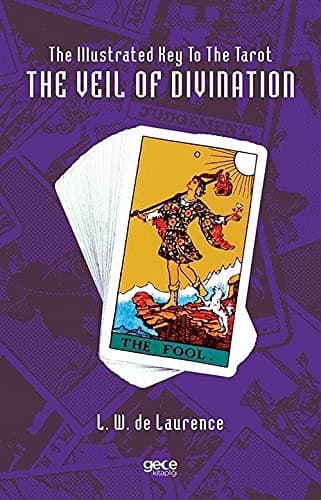
The Illustrated Key to the Tarot: The Veil of DivinationDe Laurence, L. W. (Lauron William)
Religion
The Illustrated Key to the Tarot: The Veil of Divination
De Laurence, L. W. (Lauron William)
Fortune-telling by cards; Tarot
We must set aside the fantastic attempts to extract complete
Tarot sequences out of these denaries; we must forbear from
saying, for example, that the Conditions of Life correspond to
the Trumps Major, the Muses to Pentacles, the Arts and Sciences
to Cups, the Virtues, etc., to Scepters, and the conditions of
life to Swords. This kind of thing can be done by a process of
mental contortion, but it has no place in reality. At the same
time, it is hardly possible that individual cards should not exhibit
certain, and even striking, analogies. The Baldini King, Knight
and Knave suggest the corresponding court cards of the Minor
Arcana. The Emperor, Pope, Temperance, Strength, Justice,
Moon and Sun are common to the Mantegna and Trumps Major
of any Tarot pack. Predisposition has also connected the Beggar
and Fool, Venus and the Star, Mars and the Chariot, Saturn and
the Hermit, even Jupiter, or alternatively the First Cause, with
the Tarot card of the world.1But the most salient features of
the Trumps Major are wanting in the Mantegna set, and I do not
believe that the ordered sequence in the latter case gave birth, as
it has been suggested, to the others. Romain Merlin maintained
this view, and positively assigned the Baldini cards to the end of
the fourteenth century.
If it be agreed that, except accidentally and sporadically, the
Baldini emblematic or allegorical pictures have only a shadowy
and occasional connection with Tarot cards, and, whatever their
most probable date, that they can have supplied no originating
motive, it follows that we are still seeking not only an origin in
place and time for the symbols with which we are concerned, but
a specific case of their manifestation on the continent of Europe
to serve as a point of departure, whether backward or forward.
Now it is well known that in the year 1393 the painter Charles
Gringonneur—who for no reason that I can trace has been termed
an occultist and kabalist by one indifferent English writer—designed
and illuminated some kind of cards for the diversion of
Charles VI of France when he was in mental ill-health, and the
question arises whether anything can be ascertained of their
nature. The only available answer is that at Paris, in the Bibliothèque
du Roi, there are seventeen cards drawn and illuminated
on paper. They are very beautiful, antique and priceless; the
figures have a background of gold, and are framed in a silver
border; but they are accompanied by no inscription and no
number.
Public-domain text, read in full here on John Shaqi.
Reviews
Reviews
No reviews yet
Be the first to share your thoughts on this work.
Join the Discussion
Join the discussion
Sign in to leave a comment or review.
Sign InorCreate an account